What you can see on the La Manga webcam
From a building at the northern end of the strip, the view runs south-east along a broad curve of sand backed by dunes and a brick-paved promenade. The apartment towers line up along the horizon, and the dark hump of Isla Grosa, a volcanic island protected for its seabirds, rises just offshore. It is a good camera for reading the sea, from flat calm to the white lines of a strong easterly. The picture is a sequence of images refreshed through the day.
La Manga beach webcam: Playa del Pudrimel
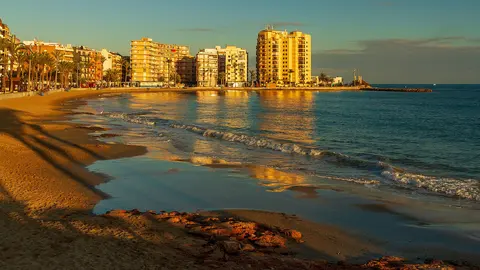
This camera sits above the promenade at Playa del Pudrimel, by Veneziola, on the open-sea side of the northern end of La Manga. It looks south-east along a long, gently curving beach: dunes fenced off with rope in the foreground, a wide strip of sand, and the line of apartment towers running down the strip to the horizon. Off the end of the bay rises Isla Grosa, the volcanic island that is a protected haven for seabirds.
The view is wide enough to judge the Mediterranean at a glance. Long, even lines of small waves mean a pleasant swim; a white, broken sea and blowing sand mean an easterly wind. In the morning the sun sits to the left of the picture and silvers the water. The image refreshes through the day as a sequence, so you can scroll back to see how the morning went.
Two seas on one strip
La Manga began as an open bay. Volcanic reefs at either end slowly trapped the sand carried by the currents until a long bar of dunes closed it off. Channels known as golas still let the two seas meet, and the contrast between them is why so many families choose La Manga: the lagoon side is shallow, warm and almost wave-free, ideal for small children and sailing lessons, while the Mediterranean side has the longer beaches, the waves and a fresher sea.
When to watch La Manga
Mainland Spain is one hour ahead of the UK and Ireland all year (UTC+1 in winter, UTC+2 in summer). This beach faces east, so the morning sun comes in from the left of the picture and the sea sparkles before lunch. Winter days are mild and often clear, which is why the strip has a loyal following of long-stay visitors.
Around La Manga
At the southern tip, Cabo de Palos has a lighthouse that has been working since 1865 and a small harbour lined with fish restaurants. Offshore, the marine reserve of Cabo de Palos and the Islas Hormigas is a well-known diving area. At the far northern end, where the road stops, the traditional fish traps of the Encañizadas sit in the shallows of the lagoon.
Visiting La Manga
One long road, the Gran Vía, runs the length of the strip, and it gets busy on summer weekends. The nearest airport, Región de Murcia International at Corvera, is just over 30 miles (50 km) away by road. There is little shade on the sand, so bring sun protection even in spring, and on windy days keep an eye on the flags on the Mediterranean side.