What you can see on the Zaragoza webcams
One camera looks along the Plaza del Pilar from high above its eastern end, with the long flank of the basilica on the right: it shows at a glance how busy the old town is and what is being set up for the next fiesta. The other looks north across the Ebro over the Puente de Santiago, with its tram tracks, its traffic and the trees along both banks. Both are still images, not video: the refresh button brings the latest one.
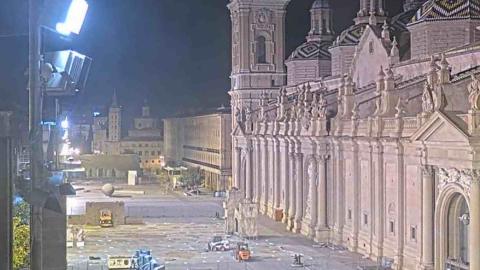
The Plaza del Pilar and the basilica, looking west
The city council's camera looks west along the Plaza del Pilar from high above its eastern end. On the right runs the long Baroque side of the Basilica of Our Lady of the Pillar, with a bell tower and its domes covered in green, yellow and white tiles; ahead, the paved square stretches away past rows of stone buildings to the church towers at the far end.
It is the camera to watch around 12 October, when stages and lighting towers go up for the Fiestas del Pilar and the flowers of the Ofrenda stand in the square for days afterwards. The rest of the year it shows the visitors, the light on the basilica and the weather. It is a still image, with the date and time printed across the top: the refresh button brings the latest one.
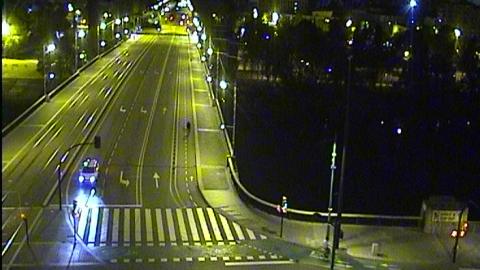
The River Ebro from the Puente de Santiago
This camera stands above the southern end of the Puente de Santiago, at the foot of the old town, and looks north across the Ebro. The bridge, opened in 1967, runs straight ahead towards the apartment blocks of the north bank, with the tram tracks along its left-hand side, the traffic lanes in the middle and a wide pavement for walkers and cyclists on the right. Beyond the parapet the river runs broad and slow between banks of trees and reeds.
The busy junction in the foreground shows how heavy the traffic is at any hour, and the water shows the state of the Ebro, which runs high and brown after heavy rain or snowmelt upstream. It is a still image, with the date and time in the corner: the refresh button brings the latest one.
The square of two cathedrals
The Plaza del Pilar is one of the largest pedestrian squares in Europe and the only one in Spain with two cathedrals: the Pilar, built between 1681 and 1872 around the pillar on which, by tradition, the Virgin Mary appeared to Saint James, and La Seo, at the eastern end. La Seo and the Aljafería palace are part of the World Heritage Site of the Mudéjar architecture of Aragon. The square is also the city's stage. On 12 October, the feast of the Pillar and Spain's national day, people in regional dress file through it from dawn until late at night for the Ofrenda de Flores, first held in 1958, and their bouquets are built into a huge mantle of flowers around a figure of the Virgin.
When to watch Zaragoza
Zaragoza is one hour ahead of the UK and Ireland. The Ebro valley is dry, with hot summers and cold, clear winters, and the cierzo, a strong north-westerly wind, can blow for days on end. The square is liveliest in the evening, when families stroll beneath the floodlit basilica, and during the Fiestas del Pilar, the week around 12 October.
Around Zaragoza
The Aljafería, an 11th-century Moorish palace that is now home to the parliament of Aragon, is a twenty-minute walk west of the square. The site of Expo 2008 lies on a meander of the river to the north-west. The walled hill town of Albarracín, in the province of Teruel, is about 115 miles (185 km) away by road.
Getting to Zaragoza
The high-speed line between Madrid and Barcelona stops at Zaragoza-Delicias station, which makes the city an easy break on the way between the two; by road each is about 195 miles (310 km) away. Zaragoza's own airport lies about 12 miles (20 km) west of the centre.