What you can see on the Portomarín webcam
A camera on the town hall turns through 180 degrees: one way to the fortress-like Romanesque church of San Xoán, the other across the main square with its lawns and arcaded granite houses. From spring to autumn, walkers with rucksacks and poles cross the picture throughout the day.
Portomarín's fortress-church and the pilgrims' square
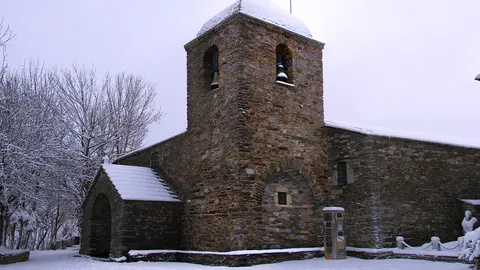
Mounted on the town hall, this camera swings through 180 degrees across the heart of Portomarín. One way, it looks straight at San Xoán, also called San Nicolás, a Romanesque church built like a castle, with a deeply carved round-arched doorway and battlements along the top. The other way, it takes in the square, with its lawns and paving, and the arcaded granite houses along its far side.
Every walker on the French Way passes through here. Sarria, the most popular starting point for the last 100 km to Santiago, is a day's walk back down the trail, so from spring to autumn a steady stream of rucksacks and walking poles crosses the picture.
The village that moved uphill
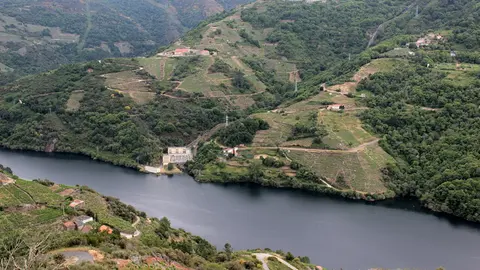
The Portomarín you see is not where the town always stood. In the 1960s the Miño was dammed to create the Belesar reservoir, and the old village by the river was drowned. Before the water rose, the most important buildings were taken down and rebuilt on the hill above, among them the church of San Xoán, also known as San Nicolás: a 12th and 13th-century church built like a castle, with battlements, a great rose window and a carved doorway. Numbers painted on its stones, to guide the rebuilding, can still be seen on the walls. In dry summers, when the reservoir falls, the ruins of the old village and its bridge reappear on the riverbanks.
When to watch Portomarín
Portomarín is one hour ahead of the UK and Ireland. The Camino is busiest from May to October, and quietest in winter, when mist can rise from the reservoir in the mornings. The camera also shows the weather walkers face on the next stage: rain, fog or sun on the hills of Lugo.
Around Portomarín
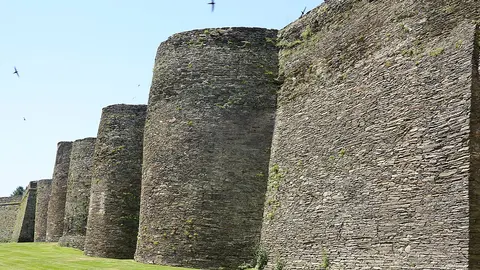
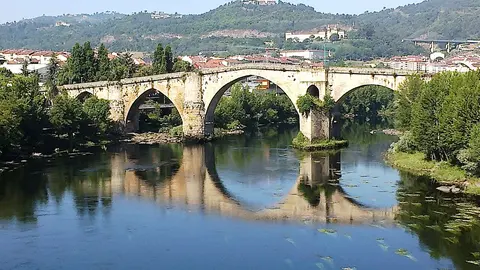
The long bridge across the reservoir is the way the Camino enters town, followed by a steep flight of steps. Lugo, with its Roman walls, is about 20 miles (30 km) to the north, and the mountain village of O Cebreiro, where the French Way enters Galicia, is a few days' walk back down the trail.
Getting to Portomarín
Santiago de Compostela airport is about 54 miles (87 km) away. Most walkers arrive on foot from Sarria, which has a railway station with trains from A Coruña and Madrid.