
What you can see on the Baiona webcams
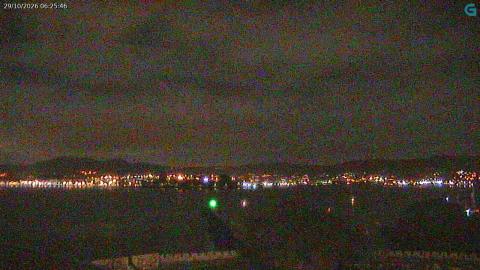
The live camera stands on the fortress of Monterreal, now a parador hotel, and turns between several views: the curtain walls and the rocky shore below them, the open bay with the Cíes on the horizon, and the marina and far shore around towards Panxón. A still image from Galicia's weather service, refreshed every few minutes, looks along a seafront path to a rocky point with a red steel sculpture, with the calm water of the bay and its wooded shores behind.
Baiona webcam: the bay and the Cíes from Monterreal
This live camera is on the Monterreal headland, inside the fortress that now houses Baiona's parador, and it turns slowly round the bay. Looking out to sea, it shows the hotel and its long stone curtain wall above a scrubby slope, the rocky shore below and, across open water, the jagged outline of the Cíes Islands with smaller islets in front. Turning the other way, it takes in the marina, the town and the far shore of the bay towards Panxón.
Use it to see how clear the air is: on a good day the Cíes stand out sharply; in haze they fade or vanish. The camera looks west, so the evenings, with the sun going down behind the islands, are its best hours.
Baiona seafront: the bay from the coastal path
Galicia's regional weather service keeps this camera by the water in Baiona. A wide-angle lens takes in a paved seafront path with lamp posts and a timber rail, running out to a grassy rocky point topped by a large red steel sculpture. Around it the granite shore drops into the calm water of the bay, with a sliver of beach on the far left and wooded headlands and hills along the far shore.
It is a still image, renewed every few minutes and stamped with the time. Because the bay is sheltered, it shows the gentle side of Baiona: how far the tide has drawn back from the rocks, whether the water is glassy or ruffled, and whether people are out walking the path.
Drake, the Pinta and the walls of Monterreal
Baiona's ties with England go back to rivalry at sea. In 1585 Francis Drake's fleet anchored off Baiona during a raid on the Galician coast, and the walls that ring the headland were built to keep raiders like him out. A century earlier the town had a happier landfall: on 1 March 1493 the caravel Pinta sailed in from the Americas, bringing the first news of Columbus's voyage to reach Europe. A full-size replica floats in the harbour.
When to watch Baiona
The bay opens to the west, so evenings are the time for the camera: the sun sets behind the Cíes, after 10pm local time in midsummer and around 6pm in December. Clear mornings show the islands sharply; on hazy summer days they can vanish completely. Baiona keeps mainland Spanish time, one hour ahead of the UK and Ireland.
Around Baiona
A path follows the walls of Monterreal right round the headland, with views of the islands. South of the town the coast road runs past the rocks of Cabo Silleiro towards A Guarda and the Portuguese border. The Cíes are reached by boat from Baiona and Vigo in the summer season; visitor numbers are capped and you need a free permit from the Galician government before booking. Vigo is about 14 miles (22 km) north.
Visiting Baiona
Vigo airport is around half an hour away by road. Baiona is also a stage on the Portuguese Coastal Way of the Camino, so expect pilgrims with rucksacks on the seafront. The beaches inside the bay are sheltered and shallow; the open coast towards Silleiro is rocky, with strong surf in bad weather.