What you can see on the Ciutadella webcams
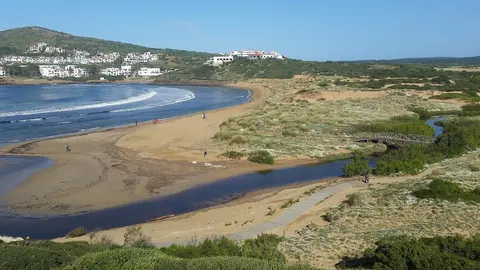
On the north coast, the view runs down a narrow inlet between low cliffs of reddish rock to the open sea, with the swimming area marked by buoys in the foreground. It is the place to judge the north wind: when it blows, swell rolls in past the rocks at the entrance. In the south-west, a camera looks from a rooftop over a flat shelf of rock to a wide stretch of sea and sky, the clearest way to read the state of the water off Cala en Bosch and how much cloud is coming in.
Cala Morell inlet
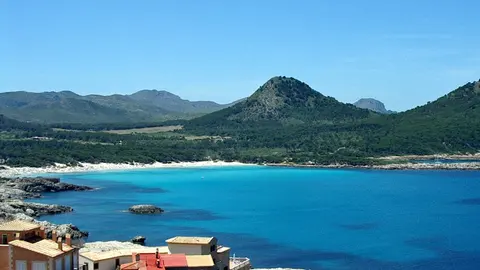
From the slope above Cala Morell, on Menorca's north coast about 4 miles (7 km) from Ciutadella, the camera looks out along the narrow inlet to the open sea. Low cliffs of reddish rock run down the left side to a jagged point, and on the right a darker headland closes the mouth. Yellow buoys mark the swimming area in the green water below.
Because the inlet opens to the north, it is the camera to check when the tramuntana is blowing: swell breaks white across the entrance and rolls in towards the beach. On calm days the water inside lies still and clear. The light is best from mid-morning, once the sun is high enough to reach into the inlet.
The sea off Cala en Bosch
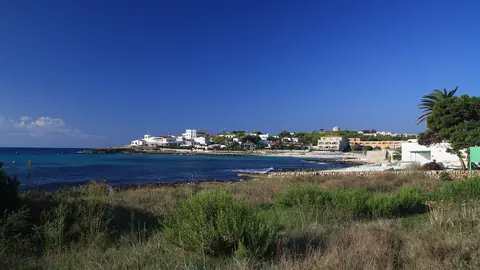
This camera sits on a rooftop near Cala en Bosch, the resort and marina at the south-west corner of Menorca, and looks over a flat shelf of pale rock straight out to sea. There is no beach in the frame: just the low rocky shore, a chimney on the left and a wide horizon of water and sky.
That simplicity is its use. Waves breaking on the rocks show how big the swell is, the surface tells you whether the wind is up, and the sky shows how much cloud is coming in. Compare it with the Cala Morell camera on the north coast: when one side of the island is rough, the other is often calm.
Caves, rock and a festival on horseback
The slopes around Cala Morell are dug with prehistoric burial caves, a necropolis that you can walk through freely just above the beach. Geologists point to something odd about the inlet itself: its two sides are made of rock from different geological eras, and you can see the change in colour from the water. Menorca's Talayotic prehistoric sites were added to UNESCO's World Heritage list in 2023. In town, Ciutadella is known across Spain for its Sant Joan festival in late June, when riders on black horses rear up among the crowds.
When to watch Ciutadella
Menorca keeps the same time as mainland Spain, one hour ahead of the UK and Ireland. The two cameras are most useful side by side: when the tramuntana blows from the north, Cala Morell turns rough while the south coast can stay calm, so a glance at both helps you choose a beach for the day. The western end of the island has the best sunsets, out over the sea towards Mallorca.
Around Ciutadella
The Naveta des Tudons, a stone burial monument from the Bronze Age, stands beside the main road east of town. South of Ciutadella lie some of Menorca's best-known coves, reached on foot along the coastal path. Ferries to Mallorca sail from Ciutadella's port.
Visiting Ciutadella
Menorca airport is at the far end of the island, roughly 24 miles (38 km) away as the crow flies. Cala Morell is about 4 miles (7 km) north-east of town and Cala en Bosch about 5 miles (8 km) south. At Cala Morell, swim inside the buoys and keep out of the inlet on days when waves break at its mouth.