
What you can see on the Muxía webcam
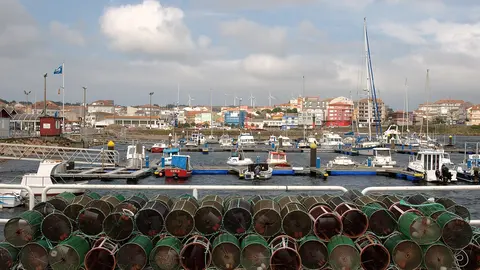
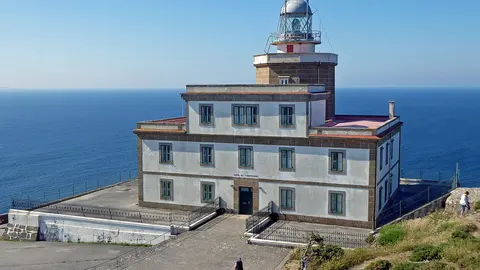
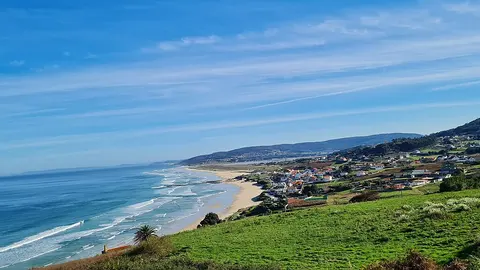
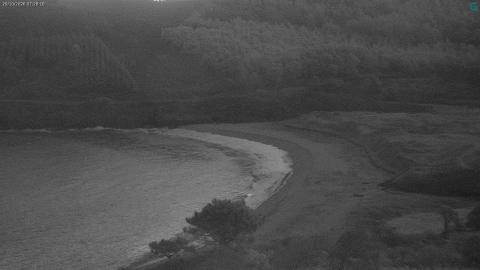
The camera turns slowly between several views. Wide, it takes in the village on its low peninsula, the hill behind it and a ridge of wind turbines on the far side of the ría. Closer in, it frames the Virxe da Barca shrine on its bare rocks at the tip, with the surf breaking around it, and the dark rocks of the shore in the foreground. Zoomed to the north, it picks out the lighthouse of Cape Vilán across the water. It is the quickest way to see how big the sea is on the Costa da Morte.
Muxía webcam: the village, the shrine and Cape Vilán
This live camera stands on the shore south of Muxía and moves between views. Wide, it shows the whole village on its low, rocky peninsula, with the bare hill behind and a line of wind turbines on the ridge across the ría. Zoomed in, it frames the Virxe da Barca shrine on the rocks at the point, where the Atlantic surf breaks white. Turned north, it reaches across the water to the lighthouse on Cape Vilán, above the rocks where HMS Serpent was wrecked.
Watch the rocks in the foreground and around the shrine to judge the sea: a little white foam means a gentle day, while plumes of spray over the point mean a heavy swell on the Costa da Morte.
The Serpent and the Coast of Death
Cape Vilán, the headland on the camera's horizon, has a British story. One stormy night in November 1890 the Royal Navy torpedo cruiser HMS Serpent ran onto the rocks below it; only three of the 176 men aboard survived. The dead were buried in a small walled cemetery on the shore that is still known as the English Cemetery. Over a century later, in 2002, the tanker Prestige sank off this coast and the oil spill blackened Muxía's shore; a split granite monument near the shrine, A Ferida, remembers it.
When to watch Muxía
Because the camera pans, give it a minute to cycle through its views. Stormy days in autumn and winter are spectacular, with waves bursting over the rocks below the shrine. In September the village fills for the pilgrimage to the Virxe da Barca, one of the best known in Galicia. Muxía keeps mainland Spanish time, one hour ahead of the UK and Ireland.
Around Muxía
About 20 minutes' drive south, Cape Touriñán is the westernmost point of mainland Spain. Inland, the Romanesque church of San Xiao de Moraime stands in a quiet valley. Camariñas, across the ría, is known for its bobbin lace and its lighthouse, and Fisterra is less than an hour's drive to the south.
Visiting Muxía
Muxía is around 50 miles (80 km) from Santiago by road, and buses link the two. The rocks around the shrine are smooth, wet and exposed to sudden waves: in a heavy sea, admire them from a distance and never climb down to the water's edge.