What you can see on the Noja webcams
One camera looks out from above the dunes over Trengandín, a long, north-facing beach scattered with reefs and rocky islets. At low tide the sand stretches far out between the rocks; at high water only their tips show above the sea. The other camera watches Ris, the town's second beach, from the grass of the dunes, with a lifeguard tower in front and the sand curving away towards a rocky point and the houses on the hill beyond. Both show live video of the waves, the tide and how busy the beaches are.
Noja webcam: Trengandín beach
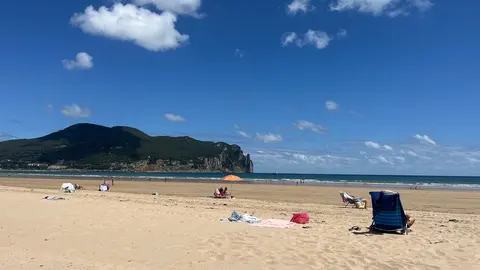
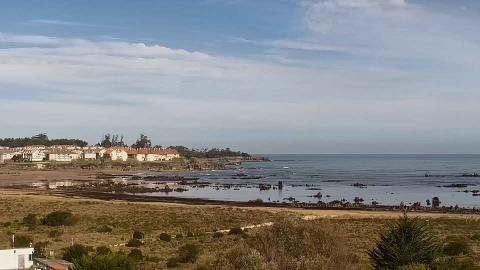
Noja town council's camera looks north from a high point above the dunes over Trengandín, the town's longest beach. In the foreground are the green bushes of the dune, then a broad band of golden sand and, out in the water, dozens of dark reefs and rocky islets scattered all the way along the shore. The open sea runs to the horizon.
The rocks make it easy to read the tide: at low water they stand high and dry with wide sand between them, while at high tide only their tops break the surface and the waves foam around them. It is live video, so you can also see people walking the sand, the colour of the sea and the clouds moving in from the Bay of Biscay.
Noja webcam: Ris beach and its dunes
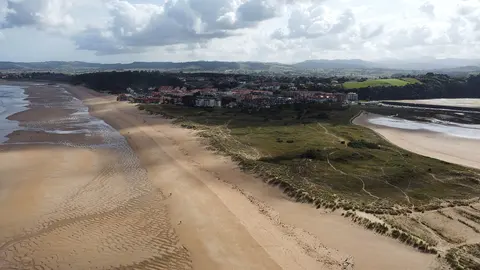
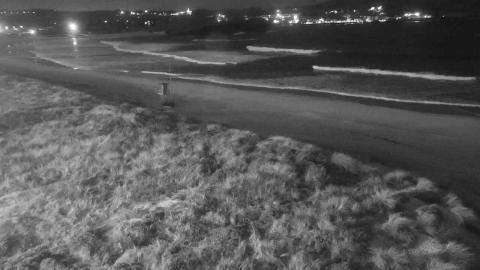
The second of Noja's cameras looks down on Ris from the grassy dunes behind the beach. A red lifeguard tower stands on the sand just below, and the beach curves away towards a rocky point, with a stream winding across the sand and the houses of the next village on the green hill beyond.
Close to the beach and at a low angle, it shows the surf well: the lines of waves rolling in, the white water on the sandbars and how the beach changes between low and high tide. In summer, the lifeguard tower and the flags around it tell you whether the beach is staffed and safe for swimming; out of season, it is often empty but for a few walkers.
Beaches between two marshes
Noja sits between two protected wetlands, the marshes of Victoria and Joyel, one at each end of the municipality. Both belong to the Natural Park of the Santoña, Victoria and Joyel Marshes, an important stopover for migrating birds on the north coast of Spain. Offshore, the town has its own small islands, among them La Oliva and San Pedruco. Trengandín, Ris and the smaller Helgueras all hold the Blue Flag for 2026.
When to watch Noja
Noja is one hour ahead of the UK and Ireland. The tide makes the biggest difference here: Trengandín at low water is a different place, with rock pools and wide sand, while at high tide on a stormy day the waves break white over the reefs. Summer days are warm rather than hot, and the evenings stay light late. Autumn and winter are the season for birdwatchers, when ducks and waders arrive in the marshes.
Around Noja
Santoña and its anchovy canneries lie a few miles east, beyond the marsh. Laredo and its long beach of La Salvé face Santoña across the bay, and Santander is about 27 miles (43 km) to the west.
Visiting Noja
Both beaches have lifeguards in season. The reefs off Trengandín make some spots unsafe at certain stages of the tide, so follow the flags and ask the lifeguards where to swim.