What you can see on the Playa Blanca webcams
One camera looks across the main basin: rows of pontoons, masts and motor yachts, the breakwater and the open sea behind it. The other watches the harbour mouth from beside the harbour office, with the marina's small stone lighthouse in front and boats coming and going. Neither shows the town beach, but both are good guides to the sea and the wind: flat water and limp flags, or whitecaps outside the wall.
Marina Rubicón from the lighthouse
Labelled Faro, this camera looks across the main basin of Marina Rubicón in Playa Blanca from beside the harbour light. Rows of pontoons fill the water with sailing yachts and motor cruisers, the breakwater runs along the back, and the open sea lies beyond. In the morning the sun is high on the left and lays a bright path across the water.
It streams live, and with so many masts in view it is a good wind gauge: flags and rigging show how hard it is blowing, and the surface of the basin shows whether a swell is getting in. The date and time sit in the top corner.
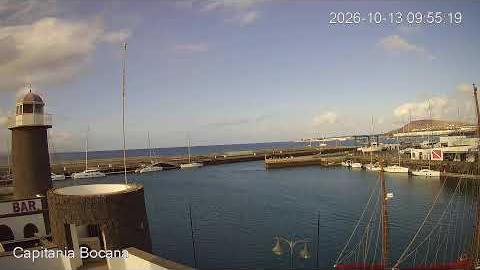
The harbour mouth at Marina Rubicón
This second camera in Marina Rubicón stands by the harbour office at the entrance to the marina. The small stone lighthouse, topped by its lantern, fills the left of the picture; past it, the inner harbour opens out, and dinghies and yachts pass through on their way in and out. On the far side are the quays and, in the distance, low hills.
It is a live view of the comings and goings of the marina rather than of the beach, and a good place to watch boats return in the evening. Whitecaps beyond the harbour wall are a quick sign of the trade wind picking up.
A marina, a watchtower and a museum under the sea
Marina Rubicón is one of the largest marinas in the Canaries, with about 550 berths and room along its quay for vessels up to 90 metres long. Two hundred metres to the east, the round Castillo de las Coloradas, built between 1741 and 1744, still stands on the headland of Punta del Águila; its bell once warned the coast that pirates were coming. Offshore lies the Museo Atlántico, an underwater museum created by the British sculptor Jason deCaires Taylor and opened in 2016: more than 300 life-size figures placed 12 to 15 metres down, visited by divers, snorkellers and glass-bottom boats.
When to watch Playa Blanca
Lanzarote keeps the same time as the UK and Ireland. The coast around Playa Blanca forms a wide bay, about 6 miles (9 km) across, split into three smaller bays, and it is usually sheltered from the north-east trade wind, which is why its beaches suit swimmers. The webcams face roughly east, so mornings are bright and back-lit; in the evening the sun sets over the western end of town.
Around Playa Blanca
East of the marina, the Papagayo beaches are a string of sandy coves below the Los Ajaches hills. Ferries cross the strait to Corralejo on Fuerteventura, and to the north lie the salt pans of Janubio, the green lagoon at El Golfo and the volcanoes of Timanfaya.
Visiting Playa Blanca
Lanzarote airport is about 14½ miles (23 km) away as the crow flies and roughly 28 miles (45 km) by road. Marina Rubicón is an easy walk along the seafront promenade from the town centre.