What you can see on the Astún webcams
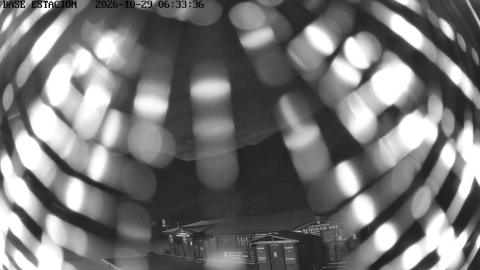
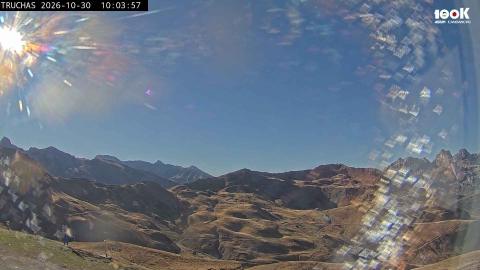
At the base, one camera looks over the rental shop, a covered conveyor for beginners, the bottom station of a chairlift and the slope climbing away behind. Higher up, a wide-angle camera takes in the upper Truchas valley, a sweep of grassy bowls and ridges ringed by the sharp summits of the frontier. A third looks down on a small mountain lake from the top of the ski area, with a lift station perched on the ridge beside it. All three are live video, and the Truchas view is also shown as a time-lapse of the last 24 hours.
Astún webcam at the base of the lifts
The first Astún camera looks over the base of the resort, where everyone starts the day. In front is the long wooden building of a ski rental shop; to the left, the covered conveyor that carries beginners up the nursery slope and the blue station of a chairlift, with the line of pylons climbing a steep grassy hillside behind.
It is the camera that shows queues at the lifts, the state of the snow at the bottom of the runs and whether people are about. In the late morning it faces straight into the sun, which fills the frame with flare, so it is easiest to read early or in the afternoon.
The high Truchas valley, the top of Astún
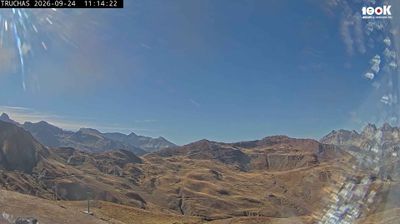
Set high in the Truchas sector, this live camera has the widest view in Astún. A fish-eye lens takes in a whole amphitheatre of grassy bowls and rocky ridges, with the sharp grey summits along the French border on the horizon and a lift pylon in the foreground.
It is the camera for the big picture: how far down the snow reaches on the upper bowls, whether the ridges are clear or wrapped in cloud, and how the light falls on the mountain. When the sun is high its lens fills with sparkles, so the clearest images come in the morning and late afternoon. Windy also shows it as a 24-hour time-lapse.
A mountain lake at the top of the ski area
This camera looks down on one of the small glacial lakes, the ibones, that lie near the top of Astún's lifts. The water sits in a hollow on the left of the frame; on the right, a lift station and a viewing platform perch on the edge of the ridge, and beyond them rise rocky peaks and a deep valley.
In winter the lake freezes and disappears under the snow, and the camera shows conditions at the very top of the pistes. In summer it is the one walkers look at: the ibones are a favourite destination, and a calm, clear lake means a good day to set out.
Lakes at the top of the pistes
Astún opened in December 1976 with just two lifts and has grown into one of the most modern resorts in the Pyrenees. It spreads over two high valleys, La Raca–Sarrios and Truchas, each reached by chairlift from the base. The pistes start at about 1,700 m (5,580 ft) and reach about 2,300 m (7,550 ft) on La Raca. The river Aragón rises within the ski area, and the resort takes its name from the Ibón de Astún, also called the Ibón de Truchas, one of several glacial lakes, or ibones, near the top of the lifts.
When to watch Astún
Spain is one hour ahead of the UK and Ireland. The season usually runs from December to April. Around midday the sun shines straight into some of the lenses, so the clearest pictures often come in the morning and late afternoon. In winter, look for fresh snow on the bowls and wind blowing it off the ridges; in summer, for clear skies over the lakes before a walk.
Around Astún
Candanchú, the neighbouring resort, is just down the road, and the Somport pass and the Way of St James a mile or two beyond. In summer the lakes above Astún are a popular walk from the base. Jaca, with its cathedral and pentagonal citadel, is the nearest town.
Getting to Astún
Astún is 21 miles (33 km) from Jaca by the N-330 and a short branch road. The nearest airports with flights from the UK are Biarritz, about 106 miles (170 km) by road, and Zaragoza, about 114 miles (183 km).