What you can see on the Benito Villamarín webcam
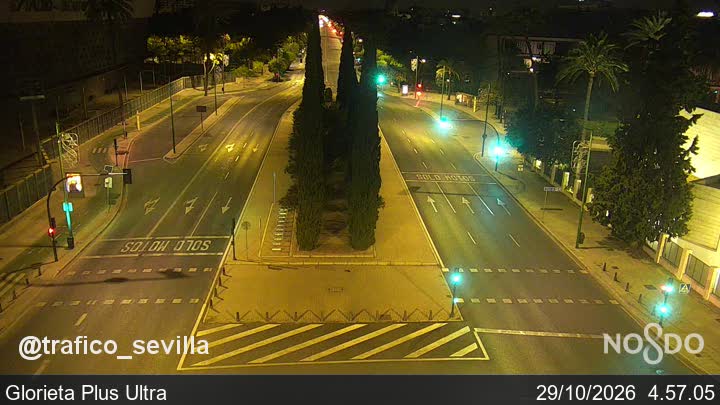
The camera stands at the Glorieta Plus Ultra and looks north up the Palmera. The stadium fills the left of the picture, with its name along the top of the stand; on the right the avenue runs away between palms and the trees of old villas. It is a traffic camera, so it shows the outside of the stadium rather than the pitch.
Benito Villamarín webcam: Real Betis' stadium from the Palmera
The city council's traffic camera at the Glorieta Plus Ultra looks north up the Avenida de la Palmera, Seville's grand avenue of palm trees and old villas. On the left rises the concrete flank of the Benito Villamarín, with the stadium's name in big letters along the top, the railings of its perimeter and the pavement where fans gather before a match; down the middle runs the avenue's central reservation of cypresses.
On match days the pavements fill with green and white long before kick-off, and the traffic slows to a crawl. The image is a still renewed every minute or two, with the time stamped in the corner.
The stadium
The ground opened in 1929, the year of Seville's Ibero-American Exposition, and has been rebuilt and enlarged several times; today it holds about 60,000. It is named after Benito Villamarín, the club president who bought it for Betis in the 1950s. Seville's other big club, Sevilla FC, plays at the Sánchez-Pizjuán, on the other side of the city, and the derby between the two is one of the most passionate in Spain.
When to watch the Benito Villamarín
Spain is one hour ahead of the UK and Ireland. Seville is one of the hottest cities in Europe in summer, and evening kick-offs are the norm; the avenue fills up an hour or two before the game. On other days the camera is simply a view of the Palmera, busy in the morning and evening rush hours.
Getting to the Benito Villamarín
The stadium is about 2 miles (3 km) south of the cathedral. Buses run along the Palmera from the centre, and the walk from the Plaza de España and the María Luisa park takes about half an hour.