What you can see on the Castelldefels webcams
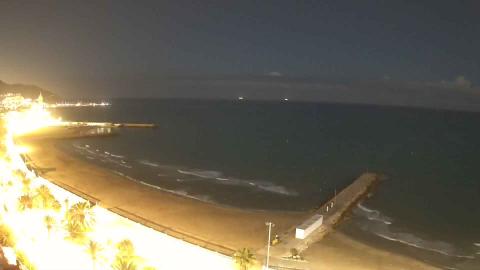
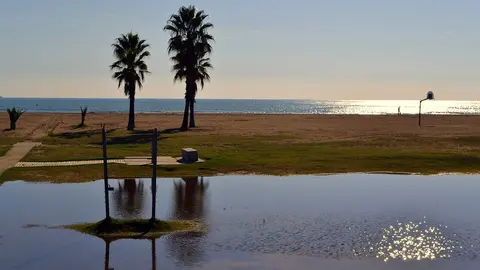
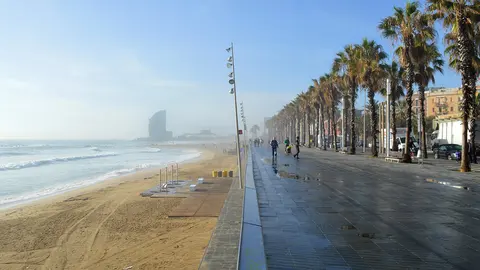
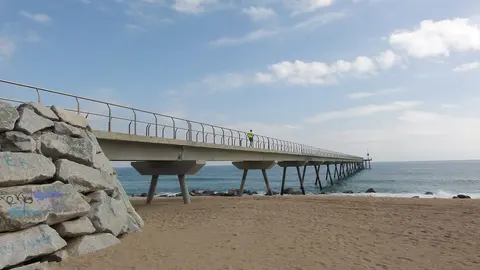
One camera streams live video from the beach beside a sailing school, looking over its catamarans and dinghies to the water's edge and the open sea, so you can see the flags stiffen and the sea turn white as the breeze builds. The other looks along the seafront from above the promenade, with palm trees in the foreground and the coast towards Barcelona fading into the distance; it is a still image, with a 24-hour time-lapse to scroll back through the day. Port Ginesta, the marina at the far south-western end of the beach, has two live cameras of its own over the harbour entrance and the outer breakwater: they are on the Port Ginesta webcams page.
Castelldefels beach webcam: the sailing school
This live stream from the Club Nàutic Castelldefels looks over the neighbouring Escola Garbí, a sailing school with its base on Castelldefels beach. Catamarans with their masts up stand in rows on the right, dinghies and rescue boats are lined up on trailers in the middle, and the Catalan, Spanish and European flags fly by the gate. Beyond the boats, the wide beach runs left along the dunes to the water's edge and the open sea.
The flags and the masts are the giveaway: hanging limp in the morning, they stretch out as the afternoon sea breeze arrives, and the sea behind turns from smooth blue to rows of white caps. It is the camera to watch before booking a lesson or heading out on a board. People close to the camera are blurred.
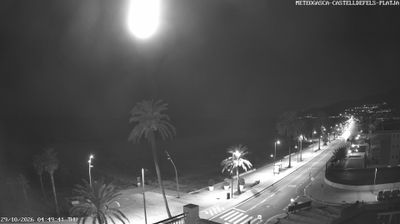
Castelldefels seafront from above the promenade
From a rooftop at the back of the beach, this camera looks south-east over the Passeig Marítim, Castelldefels' long seafront avenue. Palm trees and a strip of sandy garden fill the foreground, a footpath runs along the left, and beyond them the broad sand stretches out to a calm or ruffled sea. Far off on the left, the low coast of the Llobregat delta leads the eye towards Barcelona.
In the morning the camera faces almost straight into the sun, so the early pictures are bright and hazy; the light improves towards midday. It is a still image published through Windy, and the 24-hour time-lapse is the quickest way to see how the beach filled up and whether the wind got up during the day.
A beach made for wind
Castelldefels sits where the flat land of the Llobregat delta meets the Garraf hills, and on summer afternoons a steady sea breeze, known locally as the garbí, blows in from the south-west. That breeze has made the beach one of the busiest spots for dinghy sailing, windsurfing and kitesurfing on this coast, with schools and clubs lined up along the sand. Inland, the Canal Olímpic, a rowing lake built in the run-up to the 1992 Games, is still used for rowing, canoeing and other water sports.
When to watch Castelldefels
Spain is one hour ahead of the UK and Ireland. Mornings are usually the calmest, with flat water and few people; the wind tends to pick up after lunch, which is when the sails come out. In winter the sun sets behind the Garraf hills at the western end of the beach. The sea is at its warmest in August.
Around Castelldefels
The medieval castle that gives the town its name stands on a hill above the old centre. At the end of the beach, Port Ginesta, just across the boundary in the municipality of Sitges, has well over a thousand berths, sailing and surf schools and waterfront restaurants. To the south-west the coast road and the railway squeeze between cliffs and the sea on their way to Garraf and Sitges, about 10 miles (16 km) away. Barcelona is about 12 miles (20 km) to the north-east.
Visiting Castelldefels
Trains on the R2 line from Barcelona stop at Platja de Castelldefels station, a short walk from the sand. Two beaches, Baixador and Lluminetes, hold a Blue Flag for 2026. The beach is wide open to the wind, so bring something warm out of season.