What you can see on the Gijón webcams
From the western end, near the old fishermen's quarter of Cimadevilla, one camera looks east along the full length of the sand towards the river at the far end. Another looks back at the church of San Pedro, standing on the rocks at the end of the beach, with the stone wall of the Muro below it. A third, on the roof of a hotel at the eastern end, looks north-west along the beach and the promenade, with the River Piles crossing the sand in front and the old town on its headland in the distance.
Gijón webcam: San Lorenzo beach from the old-town end
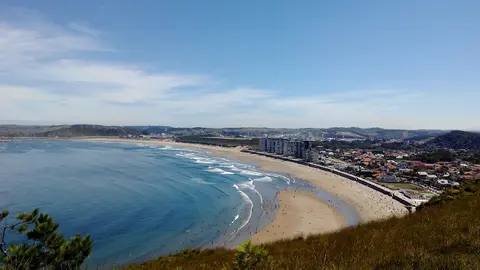
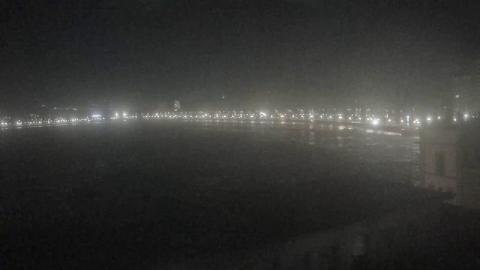
Gijón city council streams this camera from a rooftop at the western end of San Lorenzo, near Cimadevilla. Past the ribbed roofs in the foreground, it looks east along the whole curve of the beach, with the Muro and its line of tall apartment blocks on the right and the green hills behind the city in the distance.
In the morning it faces the sun, so the wet sand shines and the picture can look washed out; by the afternoon the light is behind it. It is the camera for the tide: at low water the beach is enormous, with channels and pools reflecting the sky and people walking far out, and at high water the sea reaches the foot of the wall.
Gijón webcam: the church of San Pedro
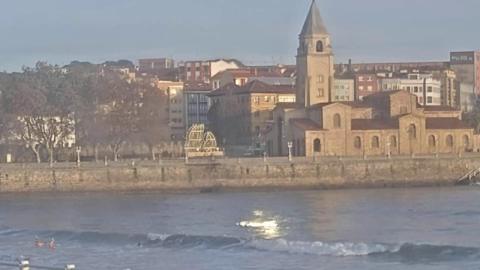
This live camera from Gijón city council looks across the western end of San Lorenzo to the church of San Pedro, with its tall square bell tower, standing on the rocky point between the beach and the old quarter of Cimadevilla. Below it runs the stone wall of the seafront, and the trees and blocks of the city rise behind.
Walkers on the promenade often pass right in front of the lens, which gives a sense of how busy the seafront is. The sand in the foreground shows the tide: wide and rippled at low water, gone at high water when the sea laps against the wall. On fine mornings the sun falls full on the stone of the church.
San Lorenzo beach from the river end
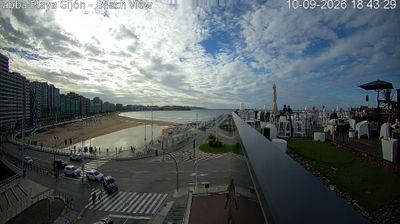
From the rooftop terrace of a hotel at the eastern end of San Lorenzo, this camera looks north-west along the beach. In front, the seafront road and crossings lead to the mouth of the River Piles, which winds across the sand into the sea; beyond, the beach stretches away under the Muro and its apartment blocks to the headland of Cimadevilla in the far distance.
This is the end of the beach where surfers gather, so the line of the breakers is worth a look. The picture is a still image updated through the day, with the date and time printed in the corner, and the 24-hour time-lapse shows how far the tide went out.
A beach that grows and shrinks
San Lorenzo is about 1,550 metres (almost a mile) long and is reached by numbered stairways from the Muro. The tidal range on this coast is so large that the beach covers around 40,000 m² at high tide and about six times as much at low tide. At high water during a winter storm, the waves break against the wall itself. Beside the church lie the remains of Roman baths, built in the 1st century and discovered in 1903, which can be visited.
When to watch Gijón
Gijón is one hour ahead of the UK and Ireland, but it lies so far west within its time zone that midsummer sunsets come after 10pm. Summers are mild and green, rarely very hot. Check the tide before a beach day: at high water the sand can almost disappear.
Around Gijón
On the hill of Santa Catalina above Cimadevilla stands Eduardo Chillida's concrete sculpture Elogio del Horizonte, put up in 1990 and nicknamed "King Kong's toilet" by locals. East of the beach, a coastal path continues to the Rinconín and smaller coves beyond. Salinas and Asturias Airport are about half an hour's drive west.
Visiting Gijón
Lifeguards patrol San Lorenzo in season. The western end, by the church, is the most sheltered part of the beach; the eastern end, near the river, is where the surfers go.