What you can see on the Haro webcams
Both stand on the same hill on the southern side of town. The first looks over the red roofs to the tower of the church of Santo Tomás and the hills along the northern skyline; the second turns towards the open vineyards and the limestone ridge of the Sierra de Toloño. They are still images, not video, and together they follow the vines through the seasons.
Haro webcam: the town and the tower of Santo Tomás
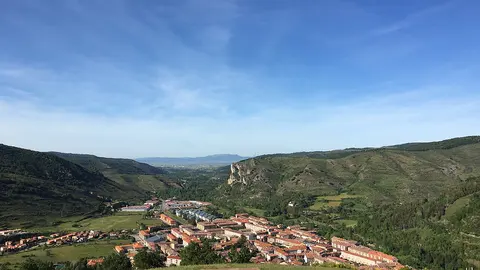
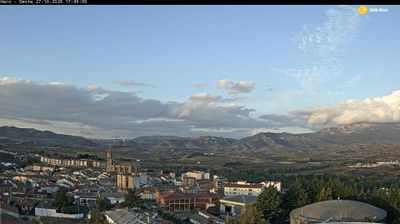
High on the hill on the southern side of Haro, beside the town's covered water tanks, this camera of the Government of La Rioja looks north over a sea of red-tiled roofs. On the left the bell tower of the church of Santo Tomás stands above the old quarter, and the newer streets run down towards the Ebro. Behind the last houses a patchwork of vineyards and fields climbs to the long line of hills that closes the Rioja Alta to the north, with the limestone crags of the Sierra de Toloño on the right. In autumn the vines turn gold and red; on winter mornings fog often fills the valley. It is a still image, not a video, labelled "Haro - Oeste" with the date and time; the refresh button brings the latest.
The vineyards of the Rioja Alta from Haro
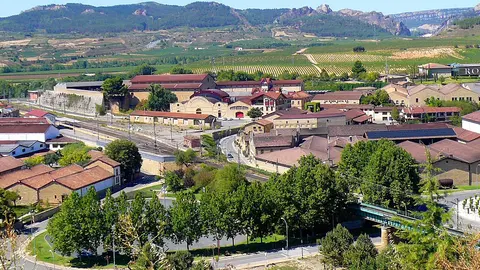
The second camera on the same hill above Haro turns north-east, away from the old town and out over the wine country. In the foreground are the newer buildings on the edge of town, a sports hall and a row of pines; beyond them the vineyards spread across a wide plain, cut by farm tracks and dotted with wineries, towards a village at the foot of the mountains. On the skyline runs the Sierra de Toloño, in the Basque province of Álava: the vines on its lower slopes, across the Ebro, belong to the Rioja Alavesa. This is the camera for following the vineyard year, from bare winter rows to the green of summer and the harvest colours of October. It is a still image labelled "Haro - Este", stamped with the date and time.
The station quarter and the wine battle
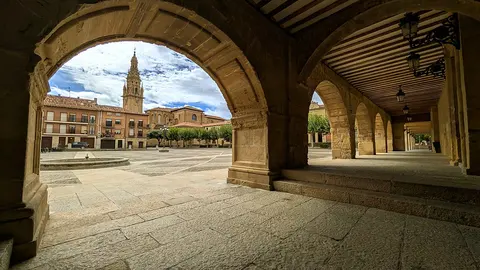
Haro grew rich on wine. When the railway arrived in the 19th century, wineries built their cellars beside the station to send their barrels by train, and the Barrio de la Estación still holds what is said to be the greatest concentration of century-old wineries in the world; several of them open their doors for tours and tastings. Haro was also the first town in Spain to light its streets with electricity, and its old quarter, around the Plaza de la Paz and the church of Santo Tomás, has been a protected historic site since 1975. Every 29 June comes the Batalla del Vino, the wine battle, when crowds climb to the crags of Bilibio and soak each other in red wine before returning to dance round the Plaza de la Paz.
When to watch Haro
Haro is one hour ahead of the UK and Ireland. The grape harvest runs through late September and October, when the vineyards on the cameras turn yellow and red; in winter they are bare and brown, and in spring a fresh green. Summer afternoons are hot, and fog often fills the Ebro valley on winter mornings.
Around Haro
Across the Ebro lie the vineyards and wine villages of the Rioja Alavesa, in the Basque province of Álava, with Laguardia on its hilltop about 17 miles (27 km) away. Santo Domingo de la Calzada is 12 miles (20 km) to the south and Logroño about 30 miles (48 km) to the east.
Getting to Haro
Bilbao airport, with regular flights from the UK and Ireland, is about 61 miles (98 km) away by road. Haro also has a railway station, with trains to Logroño and Bilbao.