What you can see on the Lloret de Mar webcam
The view is from the head of the marina at Canyelles, about 2 miles (3 km) east of the town centre. Yachts and motor boats fill the pontoons, the stone breakwater closes the harbour off from the open sea, and a wooded cliff drops straight into the water on one side. Beyond the wall you can judge whether the sea is flat or breaking white. It does not show Lloret's main beach, which lies round the headland to the west.
Cala Canyelles harbour in Lloret de Mar, live
The Club Nàutic Cala Canyelles films its own marina from the head of the harbour, at the foot of the cove about 2 miles (3 km) east of Lloret's centre. The camera looks south: in the foreground lie the boat yard and car park, with jet skis on trailers and a covered terrace; beyond them the pontoons are packed with small yachts and motor boats, and the stone breakwater closes the picture off from the open sea. On the right, a wooded cliff drops straight into the water.
Look past the breakwater to see whether the sea outside the cove is flat or flecked with white, and at the boats to see whether the day suits going out. The picture is sharpest from mid-morning, when the sun is high over the cove.
Lloret beyond the main beach
Most visitors know Lloret for its big beach and its nightlife, but the municipality has about 6 miles (9 km) of coastline, much of it rocky and green. From west to east come the coves of Santa Cristina and Sa Boadella, the wide sand of Fenals, the main town beach and, past the headland, Canyelles. A cliff path, the camí de ronda, links several of them, and in the 18th and 19th centuries many Lloret families made their fortunes in the Americas: the grand houses they built on their return still stand among the hotels.
When to watch Lloret de Mar
Lloret is one hour ahead of the UK and Ireland all year, so 10am on the camera is 9am at home. The cove opens to the south, which gives bright light on the harbour from mid-morning; late in the day the cliff throws its shadow across the water. Summer usually brings flat seas and boats coming and going all day, while autumn and winter easterlies push swell against the breakwater.
Around Lloret de Mar
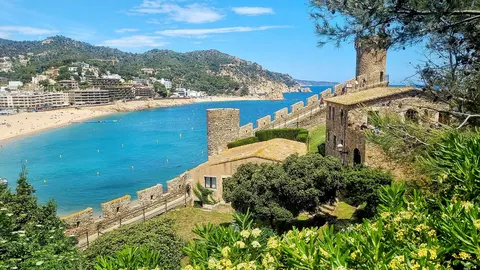
Tossa de Mar, with its walled old town on the sea, is about 6 miles (10 km) north along the coast road; Blanes, where the Costa Brava officially begins, is just to the south. Cala Canyelles has its own sandy beach beside the harbour, sheltered by the headlands on both sides.
Visiting Lloret de Mar
Girona–Costa Brava airport is about 15 miles (24 km) inland as the crow flies, and buses run to Lloret from both Girona and Barcelona airports. Canyelles sits below a steep hillside estate, a long, hilly walk from the centre.