What you can see on the Roses webcams
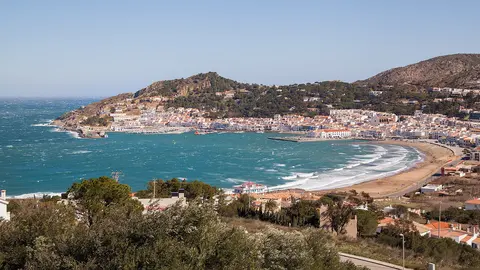
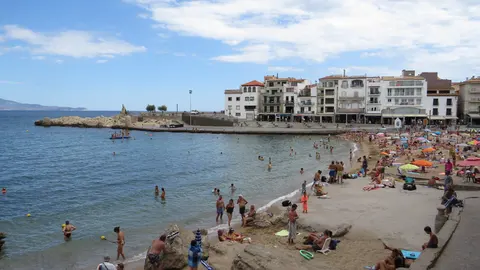
The widest view looks west across the bay: the long curve of the town beach on the right, the white blocks of Empuriabrava far across the water, and on a clear day the first mountains of the Pyrenees along the skyline. Closer in, a camera watches a stretch of sand lined with palms, good for seeing how busy it is and whether the water is flat or ruffled. From the hillside above the town, a third camera looks down on the harbour walls and the marina pontoons packed with masts, with the bay and the mountains opening out behind them.
Bay of Roses and the town beach
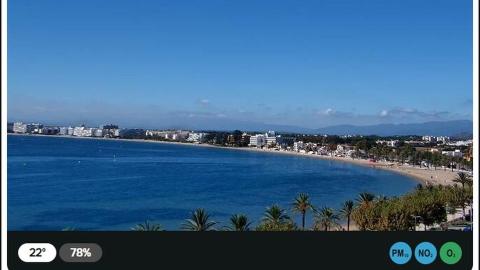
This camera belongs to the weather service of 3Cat, Catalonia's public broadcaster, and looks west across the Bay of Roses from high above the town. Below, a row of palm trees frames the view; the long, curving town beach runs off to the right, lined with hotels and apartments, and far across the water lie the white buildings of the far shore. Along the skyline, the mountains of the eastern Pyrenees close the view.
It is a still photo renewed through the day rather than video, shown with the temperature and humidity at the camera. That makes it a reliable way to check the sky and the colour of the sea, and on a clear day it shows just how far you can see across the gulf.
La Perola beach in Roses
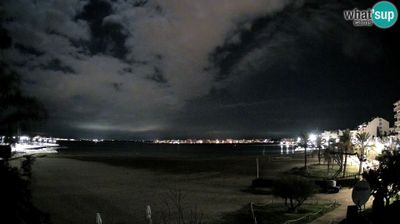
Looking along a stretch of sand on the Roses shore, this camera shows the beach close up: palms and gardens on the right, a little jetty with moored boats on the left, and the calm water of the bay beyond. Across the bay, the low white line of the far shore and the mountains behind it complete the view.
Because it is close to the ground, it is the best camera in Roses for judging how busy the beach is and whether there is any wave at the water's edge.
Roses harbour from Puig Rom
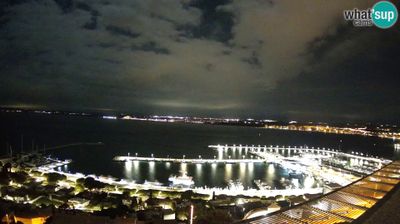
From the hillside of Santa Rosa de Puig-rom, above the town, this camera looks down on the harbour of Roses. The breakwaters and the long piers stretch into the bay, packed with boats, and the whole Gulf of Roses opens out behind them, with the line of the far shore and the Pyrenees in the distance.
It is a high, wide view, good for seeing at a glance whether the bay is flat or covered in white horses, and for watching the boats come and go. When the tramuntana blows from the north, the difference between the sheltered water inside the harbour and the open bay is plain to see. The last 24 hours play back as a time-lapse.
A Greek town and a Scottish captain
Roses began as Rhode, a Greek trading colony, and its remains can still be seen inside the Ciutadella, the walled pentagonal fortress that Charles V ordered in 1543. In 1808, during the Peninsular War, the Scottish naval captain Thomas Cochrane put his men into the Castell de la Trinitat on the headland east of town to help hold it against the French. Much more recently, Roses was home to El Bulli, the restaurant at Cala Montjoi that was named the best in the world four years running before it closed in 2011.
When to watch Roses
Roses keeps Central European Time, one hour ahead of the UK and Ireland. The town faces south across the bay, so the beach gets sun all day, and in winter the sun sets over the far side of the gulf, straight into the bay camera's view. Watch for the tramuntana, the cold, dry north wind of the Empordà: it can blow for days, mostly in winter and spring. Here it blows off the land, so the water by the beach can look calm while the bay further out turns white, under a sky swept perfectly clear.
Around Roses
North of town, the cliffs and coves of the Cap de Creus Natural Park lead to Cadaqués, a stage of about 13½ miles (22 km) on the GR 92 footpath. To the south lie the canals of Empuriabrava and the wetlands of the Aiguamolls de l'Empordà, and a road runs inland to Figueres.
Visiting Roses
Girona and Perpignan airports are both roughly 35 miles (55 km) away as the crow flies. On tramuntana days the wind pushes anything that floats out to sea, so inflatables and paddleboards are best left on the sand.