
What you can see on the Logroño webcams
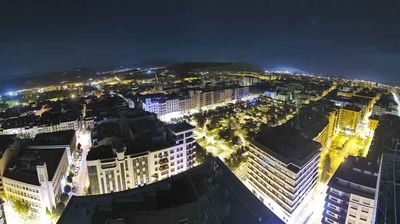
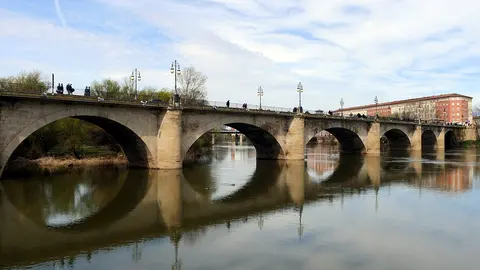
One camera looks across the rooftops of the centre to the twin towers of the co-cathedral and the hills beyond the river. Another watches the Puente de Piedra, the bridge that brings walkers and traffic over the Ebro. The third stands on a wooded hill on the south-western edge of the city, above the lake of La Grajera, with Logroño in the distance.
Logroño webcam over the rooftops to La Redonda
The city council's weather camera is mounted high on a building in the modern centre of Logroño and looks north-east over the rooftops through a wide-angle lens that bends the horizon. Below it are the tall blocks of the main streets, and in the middle of the picture the trees of the Espolón, the park at the heart of the city. Beyond them the twin baroque towers of the co-cathedral of Santa María de la Redonda rise above the old town, the bare slopes of Monte Cantabria climb on the far side of the Ebro, and a long line of mountains closes the skyline. It shows at a glance whether the sky is clear before an evening in the tapas bars of the old quarter. The council publishes a still picture; here it plays as a time-lapse of the day.
Puente de Piedra, the pilgrims' way into Logroño
This camera looks down on the Puente de Piedra, the stone bridge that carries the Way of St James over the Ebro and into Logroño. The view runs along the deck between its iron lamp posts, with the roadway in the middle, a broad pavement on either side and the wide river spreading out below the parapets, its banks lined with poplars and gardens. The present bridge was built in 1884 to replace the old one, which collapsed in 1871, and it appears on the city's coat of arms. Walkers with rucksacks are often pilgrims at the end of the day's stage from Navarre. The camera also shows how high the Ebro is running: after heavy rain or snowmelt upstream, the river rises and turns brown. It plays here as a time-lapse of the last 24 hours.
Logroño and the lake of La Grajera from the pine woods
From a pine-covered hill on the south-western edge of Logroño, this camera of the Government of La Rioja looks out over the park of La Grajera. Its reservoir, a small lake fringed with trees, lies on the right; on the left a dual carriageway curves between fields and vineyards, and the city spreads across the middle distance, with the hills of the Ebro valley behind. A green path from the city to the lake is part of the Way of St James, so this is the countryside pilgrims cross as they leave Logroño for Navarrete. On clear days the view reaches mountains on the far horizon; on hazy summer afternoons the city fades into the heat. It is a still image, not a video, with the date and time printed at the top; the refresh button brings the latest.
Wine, pinchos and the pilgrims' road
Logroño lives off the wine of the Rioja, and the vineyards come right up to the edge of town. In the evening the old quarter fills up around Calle del Laurel and Calle San Juan, two narrow streets of bars serving pinchos, small bites eaten standing up with a glass of the local red. For pilgrims, the Puente de Piedra is the way in: the present bridge was built in 1884, after the old one collapsed, and it appears on the city's coat of arms. The route then crosses the old town past the church of Santiago and heads west through the park of La Grajera.
When to watch Logroño
Logroño is one hour ahead of the UK and Ireland. Summers in the Ebro valley are hot and dry and winters cool, with fog lying along the river on still mornings. The city's biggest party is San Mateo, in the week around 21 September, when the grape harvest begins and the streets are at their busiest.
Around Logroño
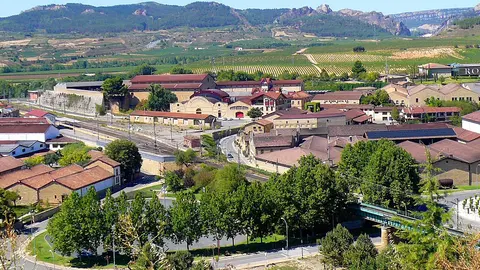
Haro, the wine town of the Rioja Alta, is about 30 miles (48 km) west by road, and the Way of St James continues through Navarrete and Nájera to Santo Domingo de la Calzada. South of the city the land climbs into the hills of the Sierra de Cameros.
Getting to Logroño
Bilbao airport, with regular flights from the UK and Ireland, is about 89 miles (143 km) away by road, most of it on the AP-68 motorway. Trains and buses link Logroño with Bilbao, Zaragoza and Madrid.