What you can see on the Salou webcams
One camera looks over the western end of Llevant, the main beach, where it meets the harbour. Old wooden fishing boats are displayed on the promenade steps, and beyond them you can see the sand raked smooth in the morning, the lifeguard post, the flag of the day and the line of sunbeds filling up. The other watches the Platja dels Capellans, a small cove towards Cap Salou, low down behind a screen of shrubs, so the waves breaking on the sand are right in front of you. Both are live video.
Salou webcam: Platja dels Capellans
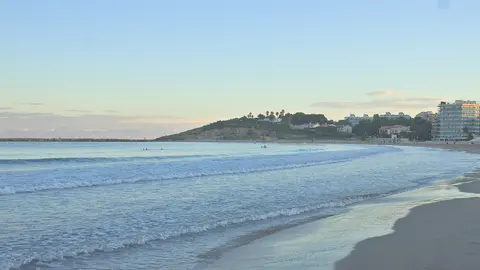
The second council camera sits low above the Platja dels Capellans, a small sandy cove on the way from Llevant towards Cap Salou. Feathery shrubs fill the bottom of the picture, a slope of sand runs down to the water's edge, and the sea fills the top half, dotted with the buoys that mark the swimming area.
Being so close to the shore, it shows the waves in detail: whether they lap gently at the sand or break in long white lines across the cove. The colours can look very blue, especially early in the morning, so judge the light by the brightness of the sand rather than the tint. On a summer day, it is also a good check on how much space is left on such a small beach.
Salou beach webcam: Llevant by the harbour
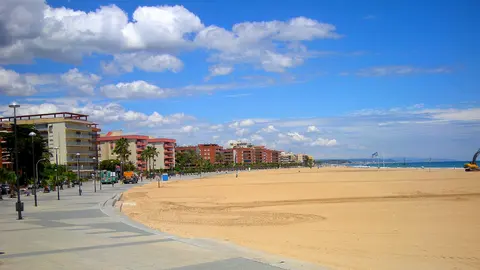
This live camera of Salou town council looks over the western end of Platja de Llevant, the town's main beach, from beside the harbour. In the foreground, stepped terraces lead down from the promenade, with old wooden fishing boats set out on the sand as a reminder of Salou's seafaring past and benches where people sit to watch the sea. Behind them the beach opens out, raked into neat curves in the morning, with a lifeguard post, the flagpole showing the bathing flag of the day and rows of sunbeds; the palms of the Passeig de Jaume I and the hotels of the seafront line the back.
It is the quickest way to see how busy Llevant is and which flag is flying before you walk down.
Where a king set sail
Salou's harbour has a longer history than its high-rises suggest. In 1229 King James I of Aragon gathered his fleet here to sail for Mallorca and take the island from the Moors, and a monument to him stands on the promenade that bears his name, the Passeig de Jaume I. Later the coast became a haunt of pirates, and in 1530 the Archbishop of Tarragona built the Torre Vella, a defence tower that still stands in the town.
When to watch Salou
Salou is one hour ahead of the UK and Ireland. The town gets more than 2,500 hours of sunshine a year, and the beaches face south, so they are bright from early morning; on July and August afternoons Llevant is packed, and the early camera images show the calm before it. Autumn brings the rain and the occasional easterly storm, when the sea turns grey-green and waves run up the sand.
Around Salou
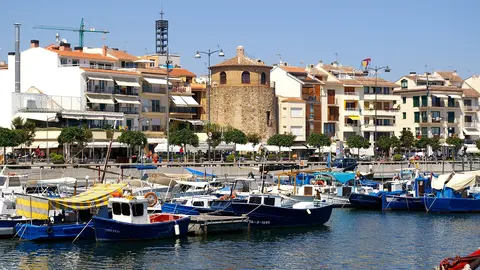
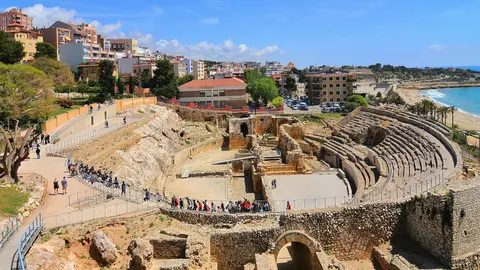
The rocky headland of Cap Salou, to the east, hides a string of small coves linked by a cliff path, and PortAventura World, with its theme parks and water park, is on the northern edge of town. Cambrils, with its fishing harbour and seafood restaurants, is about 5 miles (8 km) along the coast, and Tarragona's Roman remains are about 6 miles (10 km) away.
Visiting Salou
Reus airport, served by many flights from the UK and Ireland in summer, is about 6 miles (10 km) inland, and buses link it with the resort. The station of Salou-PortAventura has trains to Tarragona and Barcelona. The flags on the beach show whether it is safe to swim.