What you can see on the Formentera webcams
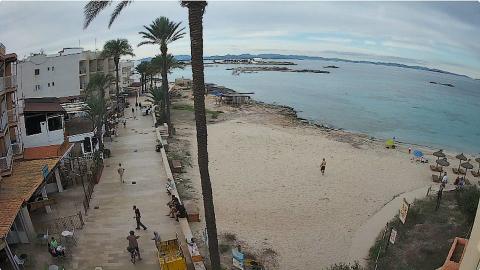
The live camera at Es Pujols looks along the seafront: the palm-lined promenade, the beach with its sunshades and the rocky islets just offshore. It is the one to watch for the state of the sea and the beach right now.
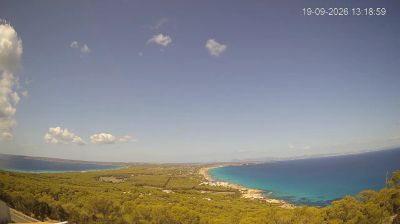
The second camera stands at the Mirador, the viewpoint where the road climbs onto La Mola, the high plateau at the island's eastern end. From up there it looks north-west along almost the whole of Formentera: pine woods in the foreground, the north coast with its rocky shore and white houses on the right, the long beach of Migjorn curving away on the left and the flat centre of the island in between. On clear days the hills of Ibiza show on the horizon. As a time-lapse of the day, it is a quick way to compare the sea on the two coasts, see the cloud and spot which side the wind is whipping up.
Es Pujols webcam: the beach and promenade, live
This camera is mounted high on a building on the seafront at Es Pujols, Formentera's main resort, and looks along the shore. On the left is the paved promenade, lined with palms, bars and low white apartment blocks; in the middle the pale sand runs down to the water, with rows of thatched sunshades towards the right. Offshore, a scatter of low rocky islets sits in a turquoise sea, with Ibiza a faint line of hills far beyond.
It is a live view, so it answers the questions that matter on the day: whether the sea is flat and see-through or ruffled by the wind, how much of the beach is taken by mid-morning, and whether the sunshades are out. It is streamed by the island's official tourism website; press play to start it.
Formentera from end to end, from the La Mola road
From the Mirador on the climb up to La Mola, this camera looks north-west down the length of Formentera. Pine woods fill the foreground; on the right, the north coast runs past white houses and a rocky shore where the waves break on windy days; on the left, the long, gentle curve of Migjorn beach fades into the distance, with turquoise water close in. Between the two coasts the flat island stretches away, and on clear days the hills of Ibiza line the horizon at the far right.
It is a time-lapse of the day: good for checking whether the sea is calm on both sides, how hazy it is and where the cloud is gathering.
Posidonia, the secret of the colour
The water around Formentera owes much of its clarity to Posidonia, a seagrass found only in the Mediterranean that forms dense meadows on the sandy seabed. The meadows between Ibiza and Formentera are among the best preserved anywhere, and since 1999 they have been part of the UNESCO World Heritage Site "Ibiza, Biodiversity and Culture". Off Formentera, Posidonia has even built up reefs about 4 metres (13 ft) high.
When to watch Formentera
Formentera is one hour ahead of the UK and Ireland all year. The La Mola view faces north-west: in the morning the sun is behind the camera and the turquoise shallows stand out, while late in the day the light turns golden and, on summer evenings, the sun sets over the sea ahead of the camera. The sea is warmest in August, at around 25 °C.
Around Formentera
At the far end of La Mola, the lighthouse stands on cliffs above the open sea, close to the village of El Pilar de la Mola. Below the viewpoint lie the fishing cove of Es Caló and the beaches of the north coast, and at the other end of the island the narrow sandbar of Ses Illetes points towards Ibiza.
Visiting Formentera
There is no airport: ferries from Ibiza Town reach the harbour at La Savina in about 30 minutes. The island is about 12 miles (19 km) long, and in summer buses link the port with the main villages and beaches.