What you can see on the Gredos webcams
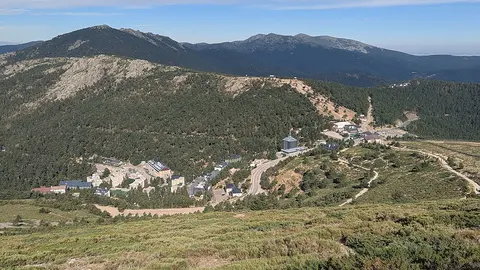
The main camera looks south-west from the village over pine forest and meadows to the high crest of the range, with the jagged peaks of the central massif on the skyline. It plays on Windy as a time-lapse of the last 24 hours, handy for seeing whether the summits were clear in the morning and how the clouds built up during the day. A second camera looks down a street in Hoyos del Espino, with its houses, bars and the meadows beyond: the place to see snow and ice in the village before driving up.
The high peaks of Gredos from Hoyos del Espino
This camera belongs to La Bodeguilla, a bar and restaurant in Hoyos del Espino, whose card is printed in the top corner of the picture. It looks south-west from the village over a farm building and green meadows, then across a dark band of pine forest climbing the lower slopes, to the summit ridge of central Gredos, where a row of jagged granite peaks breaks the skyline.
It is the camera to check for conditions on the mountains: clear and sharp after a cold night, white with the first snows of autumn, or swallowed by cloud when a storm comes in from the Atlantic. In the afternoons the sun is in front of the lens and the peaks often fade into haze. Windy plays it as a time-lapse of the last 24 hours.
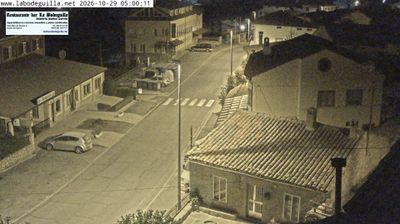
A street in Hoyos del Espino
La Bodeguilla's second camera looks down from a rooftop on a street in Hoyos del Espino, the village at the foot of the Gredos peaks. On the left is a long, low stone building with a bar-restaurant sign and cars parked in front; the road runs away past a zebra crossing and a row of recycling bins to a cream-coloured building with arcades, and old granite houses with tiled roofs fill the right of the frame. Green meadows and stone walls show behind the village.
It is not a mountain view, but it answers a practical question for anyone driving up to the Plataforma de Gredos: is there snow or ice on the roads in the village? It plays on Windy as a time-lapse of the day.
Granite, glaciers and ibex
Gredos is a range of granite shaped by ice. On its northern side the glaciers of the last ice age carved deep cirques, the largest of them the Circo de Gredos, where the Laguna Grande lies beneath the Almanzor and its neighbours. The central part of the range is a regional park of about 86,000 hectares (330 square miles), home to a large population of Iberian ibex, which are often seen at close quarters by walkers around the lake.
When to watch Gredos
Spain is one hour ahead of the UK and Ireland. The camera faces the sun from midday into the afternoon, so summer days often bring haze over the peaks, while the sharpest views come on cold, dry mornings in autumn and winter after a front has passed. Snow usually covers the summits from late autumn well into spring.
Around Hoyos del Espino
A road climbs about 7 miles (12 km) from the village to the Plataforma de Gredos, where the path to the Laguna Grande begins. Each summer Hoyos del Espino hosts Músicos en la Naturaleza, an open-air music festival that has brought artists such as Bob Dylan and Sting to the foot of the mountains. On the southern side of the range, facing Extremadura, lies the valley of La Vera.
Getting to Gredos
Hoyos del Espino is about 120 miles (193 km) from Madrid-Barajas airport by road, and about 45 miles (73 km) from the walled city of Ávila. The village stands at about 1,500 m (4,900 ft), so in winter carry chains and check the state of the mountain passes before setting off.