What you can see on the Segovia webcams
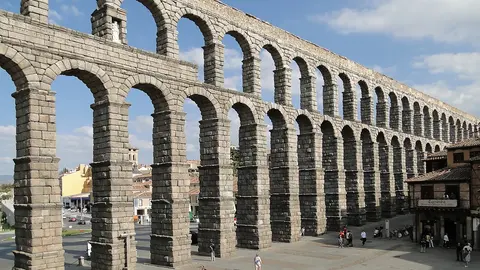
The live camera looks across the upper tier of the aqueduct to the old town on its ridge, where the towers and domes of the cathedral rise above the rooftops. It was set up to watch the city's birds, so swifts, choughs and storks often fly through the picture. The still image is taken from the Plaza del Azoguejo, under an arch at the edge of the square, and shows the aqueduct at its tallest, with the cafés, the crowds and the light on the stone.
Segovia's aqueduct and cathedral, live
Directo Natura's camera 91 is on a secondary school, the IES Mariano Quintanilla, in a project with Segovia city council to watch the birds that share the city with its people. It looks across the top tier of the Roman aqueduct, its granite arches running along the lower half of the frame, to a crenellated stretch of the old walls and the long façades of the upper town. Behind them rises the cathedral, with its pinnacles, its dome and its tall bell tower capped by a cupola.
Swifts in summer, red-billed choughs and white storks fly through the picture. In the afternoon the stone glows golden, and at night the floodlit aqueduct shines below the dark bulk of the cathedral.
The aqueduct over the Plaza del Azoguejo
The city's tourism office publishes this picture from the Plaza del Azoguejo, the square where the aqueduct reaches its greatest height. The camera looks out from under an arch at the edge of the square, whose dark edge frames the top corner, along the double tier of granite arches as they stride across the square towards the old town; on the right are tall houses with balconies and café terraces under white umbrellas.
It shows how crowded the square is, the colour of the light on the stone and whether it is raining or snowing. It is a still image, not a video; the refresh button brings the latest one.
The aqueduct and the old town
The Romans built the aqueduct around the end of the 1st century AD or the beginning of the 2nd to bring water to the city from springs in the mountains about 11 miles (17 km) away, and it kept doing so until 1973. Its granite blocks, around 25,000 of them, are held together without mortar, and at the Azoguejo the arches stand about 28 m (92 ft) high. The cathedral, consecrated in 1768, was the last great Gothic cathedral built in Spain and is known as the Lady of Cathedrals; at the western tip of the ridge stands the Alcázar, the fairy-tale royal fortress. The old town and its aqueduct have been a World Heritage Site since 1985.
When to watch Segovia
Spain is one hour ahead of the UK and Ireland. Segovia stands at about 1,000 m (3,300 ft), so its winters are cold and snow sometimes dusts the arches, while summer days are hot and evenings cool. The cathedral glows in the afternoon light, and after dark the aqueduct is floodlit.
Around Segovia
The royal palace of La Granja de San Ildefonso, with its fountains and gardens, is a short drive towards the mountains, and the road beyond climbs to the Navacerrada pass, whose mountain webcams show the snow in winter. Segovia is famous for roast suckling pig, served in the restaurants around the aqueduct.
Getting to Segovia
High-speed trains from Madrid Chamartín reach Segovia in about half an hour, making it an easy day trip from Madrid. Madrid-Barajas airport, with many flights from the UK and Ireland, is about 44 miles (71 km) away as the crow flies; the high-speed station is on the edge of the city, with buses to the aqueduct.