What you can see on the Valdesquí webcams
The resort's own camera, called Estadio, looks across the open slopes to a mountain building with railed terraces and a lift behind it. Two more, from the Venta Marcelino restaurant on the Puerto de Cotos, show the road over the pass with its bus stop, and the big car park against the pine-covered mountains. Together they tell you whether there is snow, fog or a line of cars before you leave the city.
Valdesquí webcam over the Estadio area
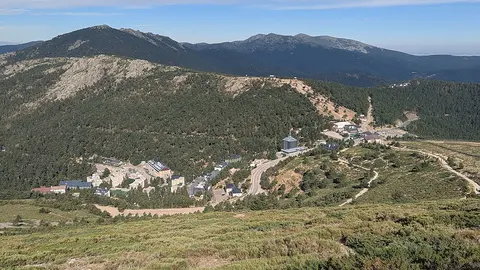
This is Valdesquí's own camera, which the resort calls Estadio. It looks down across an open slope to a mountain building with railed roof terraces and a lower deck, with a lift structure on the hillside behind it and a long line of snow fencing across the grass in the foreground.
For skiers it is a quick check of the snow cover around the buildings and along the fences: when the grass and the fence posts disappear under white, there is snow on the pistes. It also shows the visibility, since in low cloud the building fades or vanishes altogether. It is a still image, not video, with the camera's name, the date and the time printed in the corner: the refresh button brings the latest one the camera has sent.
The road and bus stop on the Puerto de Cotos
This camera belongs to the Venta Marcelino, a restaurant that has stood on the Puerto de Cotos since 1924, and looks west along the road over the pass. In front are a paved forecourt with planters and a path, with stone steps climbing the grassy bank on the right; beyond, the road curves past the bus bay painted on the tarmac and a green sign for Castile and León. Pines line both sides, with a distant summit in the gap.
In winter it shows whether the road is white or clear, whether the ploughs have been through and how many walkers and sledgers are setting off from the pass. Windy shows it as a time-lapse of the day.
The car park on the Puerto de Cotos
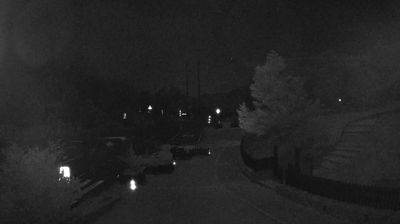
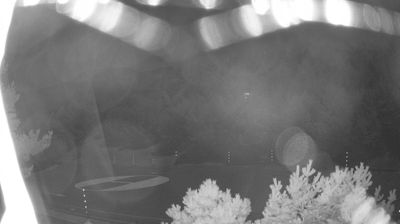
The second Venta Marcelino camera faces roughly south, over the large car park beside the pass, marked with a white helicopter landing circle. Behind it a slope of pines rises steeply, and on the left, beyond a power pylon, a bare, rocky summit of the Guadarrama stands above a forested valley.
This is the view to check before a winter weekend in the mountains: when there is snow the car park can fill early, and a full car park is the cue to take the train from Cercedilla instead. The summit on the left is where fresh snow shows first, and low cloud often rolls over it while the pass is still clear. Windy plays it as a time-lapse of the day.
Madrid's ski resort
Valdesquí is run by the company Estación Alpina de Cotos and has about 22 km (14 miles) of pistes between roughly 1,860 m (6,100 ft) and 2,260 m (7,410 ft), served by chairlifts and drag lifts. Because its slopes face north, they hold the snow better than most in a range so close to the capital. One of its runs, approved by the International Ski Federation for races, is named after Francisco Fernández Ochoa, who grew up in Cercedilla, at the foot of these mountains, and in 1972 became the first Spaniard to win a Winter Olympic gold medal. Since 2013 the high ground around the resort has been part of the Sierra de Guadarrama National Park.
When to watch Valdesquí
Spain is one hour ahead of the UK and Ireland. The ski season usually runs from December to April, depending on the snow, and weekends bring the crowds from Madrid: the car park view shows how full the pass is. Fog can sit on the ridges while the sun shines in the city, and strong wind can close the upper lifts.
Around Valdesquí
From Cotos a well-trodden path climbs through the pines to the glacial lakes of Peñalara and on to its summit, at 2,428 m (7,966 ft). The Puerto de Navacerrada, the neighbouring pass, is about 5 miles (8 km) away, and the road north drops into the Lozoya valley towards Rascafría and the monastery of El Paular.
Getting to Valdesquí
Madrid-Barajas airport, with flights from all over the UK and Ireland, is about 47 miles (76 km) from the resort by road. The narrow-gauge mountain railway from Cercedilla ends at Cotos station, about 1.7 miles (2.8 km) from the slopes, and there are buses from Madrid. In winter, carry chains and check the state of the mountain roads before setting off.