What you can see on the Peñafiel webcams
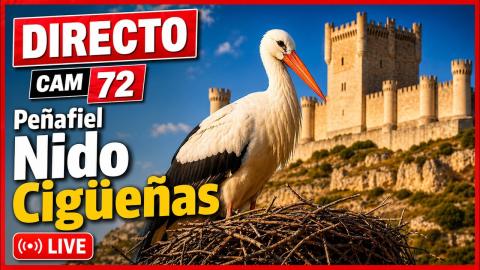
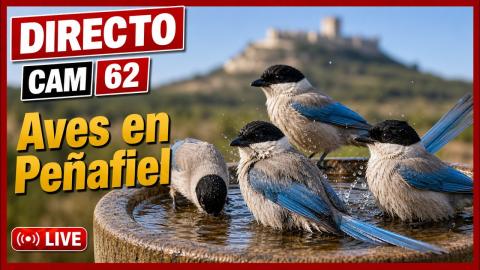
One camera sits beside a white stork's nest on a church tower in the middle of town, with tiled roofs, a bell tower and the whole length of the castle on its hill behind. The other watches a small stone fountain where birds come to drink, on a wine estate outside the town, with rows of vines falling away to the castle on the horizon.
Peñafiel castle from the storks' nest
Camera 72 of Directo Natura, a project with Peñafiel town council, is fixed beside a white stork's nest on the tower of the church of Santa María, in the middle of the town. The great pile of sticks fills the foreground; behind it are the tiled roofs and coloured façades of the town, a stone bell tower with a small dome, and above everything the castle, stretched along the top of its hill like a ship, with the keep in the middle.
The storks build up the nest each year, lay their eggs in spring and raise their chicks in it into early summer; outside the breeding season, the camera is simply the best live view of the castle. On the slope below the walls, look for the little white chimneys that ventilate the old wine cellars dug into the hill.
Birds at a fountain in the Peñafiel vineyards
Camera 62 of Directo Natura is set up on the Pago de Carraovejas estate, a winery in the Ribera del Duero just outside Peñafiel, as part of the town council's nature project. In the foreground is a small fountain built of stacked stone slabs, where water trickles into a shallow basin and sparrows and other small birds come to drink and bathe. Behind it, rows of vines run down the slope, with pines on either side, and far off on the horizon the castle of Peñafiel stands on its flat-topped hill.
It is a close-up of the birds of the vineyards and a wide view of the Duero valley at once. The vines are green in summer and turn gold after the grape harvest in autumn.
A castle shaped like a ship
A fortress has stood on this hill since at least the 10th century; legend says the Castilian count Sancho García, who took it in 1013, called it the most faithful rock of Castile, the peña fiel that gave the town its name. The present castle is about 200 m (660 ft) long but only about 35 m (115 ft) wide, ringed by battlemented walls with a keep about 34 m (112 ft) tall at its centre. It has been a national monument since 1917, and since 1999 one of its wings has housed the Provincial Wine Museum of Valladolid. The hillside below is honeycombed with old underground wine cellars, some dating from the late 15th century.
When to watch Peñafiel
Spain is one hour ahead of the UK and Ireland. At 754 m (2,474 ft) on the plateau, Peñafiel has hot summer days, frosty winter mornings and frequent fog in the Duero valley. The vines turn gold and red after the harvest in autumn. On Easter Sunday the Plaza del Coso hosts the Bajada del Ángel, when a child dressed as an angel is lowered from a wooden tower to lift the mourning veil from the Virgin, a festival of national tourist interest.
Around Peñafiel
The Plaza del Coso, a rectangular square lined with old houses and wooden balconies, is one of the earliest main squares in Spain and still serves as a bullring during the August fiestas. Wineries line the Duero valley in both directions, from Protos at the foot of the castle, the cooperative where the Ribera del Duero's modern wine story began in 1927, to the famous estates towards Valbuena de Duero.
Getting to Peñafiel
Valladolid is about 35 miles (56 km) to the west. Madrid-Barajas airport is about 85 miles (134 km) away as the crow flies, and the ferry port of Santander about 130 miles (210 km).