
What you can see on the Playa del Inglés webcams
The cameras show the beach where it meets the dunes, the sand seen from sea level and the coastline from high ground at El Veril. Together they answer the usual questions before heading out: is it sunny, is the beach busy and are the waves up. Away from the sea, the Yumbo Centre in the middle of the resort has a camera of its own, turning over its terraces: it is on the Yumbo Centre webcam page.
Playa del Inglés beach from the sand
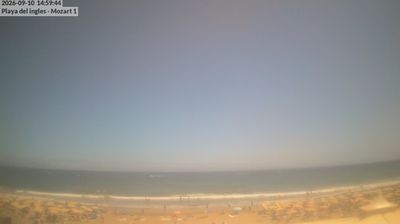
Set almost at beach level, this camera looks straight out to sea across the sand of Playa del Inglés. It faces east-south-east, so on clear mornings the sun climbs into the frame and lays a bright path across the water; by the afternoon the light is behind it and the sea shows its true colour. The wide lens bends the horizon a little.
It is shown here as a time-lapse of the last 24 hours, which makes it easy to see when the beach filled up, whether the morning cloud burned off and how the waves changed through the day. Small figures at the water's edge give a sense of scale.
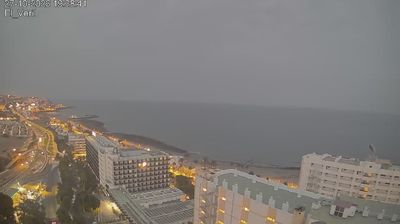
The coast from El Veril, Playa del Inglés
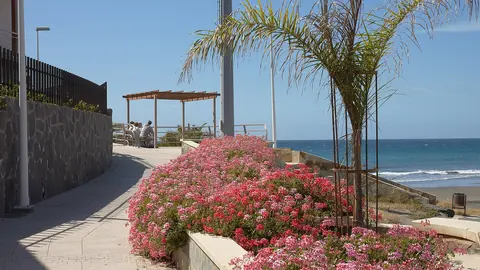
From high on a building at El Veril, at the eastern end of Playa del Inglés, this camera looks east along the coast. Below are hotel blocks and a main road with its slip roads; beyond them a run of small beaches and breakwaters leads towards San Agustín, while the open Atlantic fills the right-hand side of the frame.
In the morning it points into the sun, which can wash out the picture for an hour or two; the afternoon view is much sharper. Its height makes it useful for reading the sea over a long stretch of shore: white lines along the breakwaters mean a swell is running. It is shown as a time-lapse of the last day.
Playa del Inglés webcam: where the beach meets the dunes
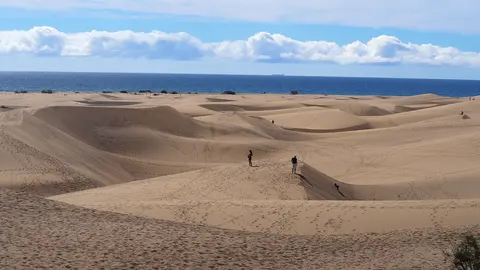
This live view comes from a holiday apartment building just back from the promenade of Playa del Inglés and looks south over the first ridges of the Maspalomas dunes to the shore. Sand hills and scrub fill the foreground; behind them is a broad band of flat beach where people walk along the water's edge, and then the Atlantic.
Morning light, from the left, picks out every ripple in the sand. It is a dependable guide to the sea, the number of people out on the beach and the strength of the wind: when the trade wind is up you can see sand streaming off the crests. The clock in the corner runs on Canary time, which is the same as in the UK and Ireland.
An Englishman's beach?
The name means "the Englishman's beach", and nobody is entirely sure which Englishman. The usual story credits a bohemian who settled on the empty shore early in the twentieth century; another version says he was really French and the local people simply took him for English. Either way the name was there long before the resort, and the beach is now shared by holidaymakers from all over northern Europe.
When to watch Playa del Inglés
The beach faces east of south, so it catches the sunrise and stays in sunshine for most of the day. Mornings are usually the calmest time; the trade wind tends to pick up after midday, which is when sand starts to blow off the dunes. The clocks here match those in the UK all year round, so a sunny scene at 9am on the camera means 9am back home too. In winter the sea rarely drops much below 19°C.
Around Playa del Inglés
Walk south-west along the shore and within minutes you are among the dunes, with the Maspalomas lighthouse at the far end of the beach. North-east, a coastal promenade leads past the coves of Las Burras to San Agustín, and the Yumbo Centre, with its bars and restaurants, is at the heart of the resort's nightlife.
Visiting Playa del Inglés
The beach is reached from the promenade above it, with steps and ramps down at several points. Sunbeds and parasols are rented in sections and flags show when it is safe to swim. The stretch nearest the dunes has long been used by naturists, so expect some sunbathers without swimwear. Away from the sea, the GC-1 motorway links the resort with the airport and with Las Palmas.