

What you can see on the Santa Ponsa webcams
One view looks down across the beach and the moored boats to the wooded southern shore and the open sea beyond, so you can see how busy the sand is and whether the bay is flat or rippled by the breeze. Another faces the other way, over the water to the hotel blocks and up to the Serra de Tramuntana, the clearest way to tell if cloud is sitting on the mountains. A third, a couple of miles south at El Toro, looks over the pontoons and superyachts of Port Adriano to the harbour mouth.
Santa Ponsa beach webcam: the sand and the bay
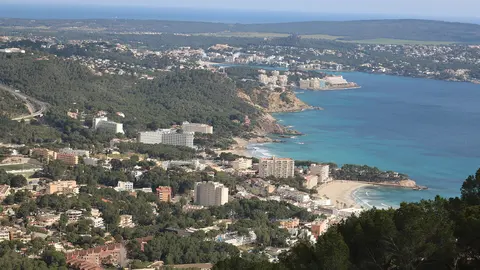
This camera stands high on the north side of the bay and looks south-west over the rooftops. On the left the main beach curves away under its palms and rows of parasols; in the middle the water is dotted with moored boats; across the bay, the pine-covered southern shore rises to a low hill scattered with villas, and on the far right the bay opens to the sea.
It is the view for judging the beach itself: how many sunbeds are taken, whether the water is the pale turquoise of a calm day or ruffled by the wind, and how far the swimmers are spread along the shore. In the afternoon the light comes round onto the bay and the colours are at their best.
The Tramuntana mountains over Santa Ponsa
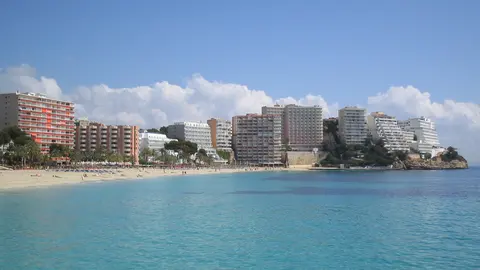
From the wooded slopes on the south side of Santa Ponsa, this camera looks north across the bay. Villa roofs and umbrella pines fill the foreground, a strip of blue water runs across the middle, and beyond it the hotels and apartment blocks of the town line the far shore. Behind them stands the Serra de Tramuntana, with the pointed summit of Galatzó, a little over 1,000 metres (3,300 ft) high, near the centre of the skyline.
The beach itself is hidden behind the trees, so this is a camera for the weather rather than the sand: whether the peaks are clear or wrapped in cloud, how the light falls on the town and whether a shower is coming down from the hills. Late in the day the mountains glow in the evening sun.
Superyachts and the harbour mouth at Port Adriano
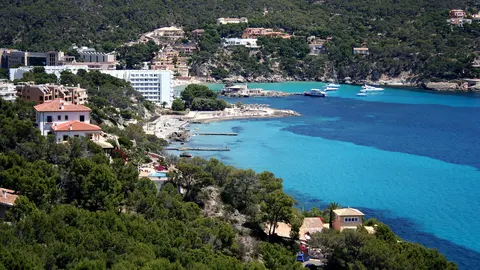
Port Adriano is the marina of El Toro, about 2 miles (3 km) south of Santa Ponsa beach, and this camera looks across its basin from a high point on the shore. On the right, the largest yachts are moored stern-to along the outer breakwater; on the left, smaller boats fill the pontoons in front of the low marina buildings, and above them golden sandstone cliffs and a pine-covered headland dotted with houses. Beyond the harbour mouth lies the open sea, with a small rocky islet on the horizon.
Watch the yachts coming and going through the entrance, the colour of the water in the basin and the state of the sea outside the breakwater: white caps beyond the harbour wall mean a lively day for anyone heading out by boat.
The bay where Majorca's history turned
In September 1229 King James I of Aragon landed his army in this bay to take Majorca from its Moorish rulers, and a stone cross by the entrance to the marina marks the spot. The landing is remembered every September with the town's fiestas, which include a mock battle of Moors and Christians on the beach. Much older still is the Puig de sa Morisca, a hill above the town where an archaeological park preserves the remains of an Iron Age settlement.
When to watch Santa Ponsa
Majorca keeps the same time as Spain, one hour ahead of the UK and Ireland. The bay opens to the south-west, so the afternoon brings the best light on the water and evenings end with the sun setting over the sea. Mornings are usually the calmest time for swimming or paddleboarding, before the afternoon breeze fills in. The sea is warmest in August and coolest in February and March.
Around Santa Ponsa
Port Adriano, designed by Philippe Starck, has shops and restaurants along its quays and berths for superyachts of more than 50 metres (165 ft). Peguera and its beaches are a short drive west, and Magaluf and Palmanova lie a few miles east along the coast. The town also has three golf courses.
Visiting Santa Ponsa
Palma airport is about 20 miles (33 km) away by motorway. The beach shelves gently and the water inside the bay stays sheltered from most winds, which makes it a good choice for young children; lifeguards cover it in the summer season. Boats leave from the bay for trips along the coast.