What you can see on the Cala Agulla webcams
Both are live video streams from Playas de Capdepera, the website of the municipality's beaches. Together they answer the questions people ask before setting off: how far the parasols have spread, whether the water is still and clear or breaking white, and how the sky looks over the bay. The Cala Ratjada webcams cover the town itself, from the town beach of Son Moll to the harbour and the little cove of Cala Gat.
Cala Agulla from the headland
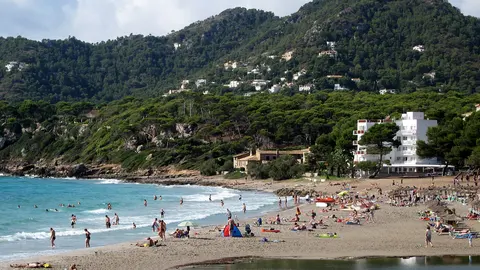
From a rocky point at one end of Cala Agulla, this camera looks across the whole bay. In the foreground a path winds over the headland through low scrub, and beyond it lie the curve of white sand, the turquoise water and the green hill that rises from the far end of the beach.
It shows the setting of Cala Agulla better than the camera on the sand: the woods behind the beach, the full width of the bay and the swell running in from the sea. It is a good way to see the sky and the light over the bay before a walk on the coastal paths.
Cala Agulla beach webcam
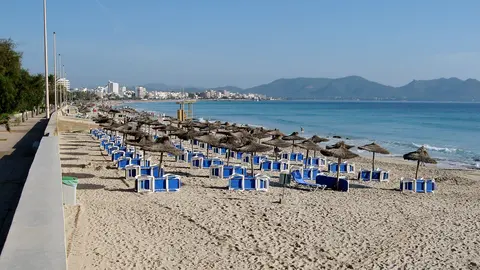
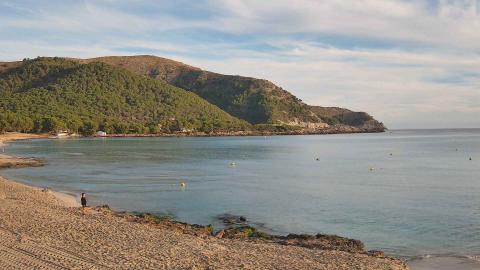
Down at sand level on Cala Agulla, the beach just north of Cala Ratjada, this camera looks along the shore towards the pine-covered headland that closes the bay. Straw parasols stand on the white sand, rocks break the water's edge and the surf rolls in from the open sea.
It is the best camera for the waves on Cala Agulla, which is more exposed than the town beach: on calm days the water is clear and shallow, and with a north-easterly the shore becomes a band of white foam.
A beach the builders never reached
In 1991 the Balearic Parliament declared Cala Agulla, together with its neighbours Cala Moltó and Cala Mesquida, a Natural Area of Special Interest, which kept this stretch of coast free of development; since 2023 Cala Agulla and Cala Mesquida have also been part of the enlarged Llevant Peninsula Natural Park. Behind about 500 metres (a third of a mile) of fine white sand lies a belt of dunes, roped off and signposted so that the protected plants and animals that breed there are left alone, and beyond them a large pine wood. The beach is never quite the same size: depending on the wind, it grows or shrinks by up to 10 metres (33 ft).
Calm water, and the north-easterly
On a still day the sand shelves gently and the water stays shallow, which is why the council recommends Cala Agulla to families with small children. The bay faces north-east, though, and that is where its waves come from: when the wind blows from that quarter the swell rolls straight in, and rip currents can form along the beach. In the bathing season lifeguards watch over the sand, and a buoyed-off area is set aside for kayaks, sailing dinghies and paddleboards.
When to watch Cala Agulla
Spain is one hour ahead of the UK and Ireland. With the bay turned to the north-east, the summer sun comes up over the open sea in front of the beach; in winter it rises further round to the south-east, towards Cala Ratjada. The lifeguards, kiosks and sunbeds are there in the bathing season; the rest of the year the cameras show a much quieter beach.
Getting to Cala Agulla
The beach is less than a mile and a half (about 2 km) by road from the harbour of Cala Ratjada and just over 2 miles (3.7 km) from Capdepera, the old town inland. Paths lead through the pines to the small cove of Cala Moltó next door and, over the Coll de Marina, to Cala Mesquida, a route used by walkers, mountain bikers and riders; the Cala Mesquida webcam shows that open, north-facing beach.