What you can see on the Llafranc and Calella webcams
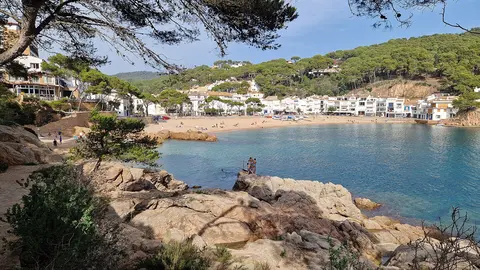
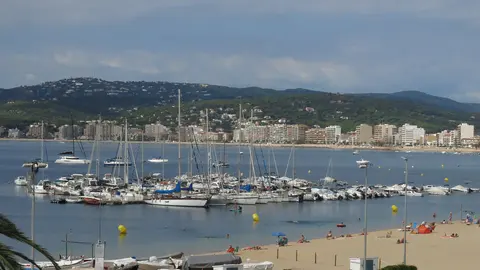
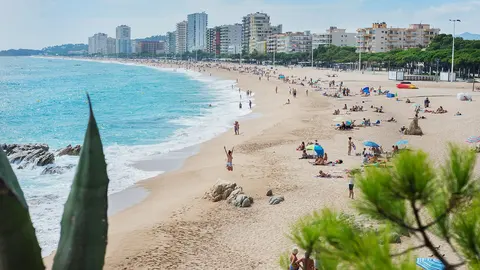
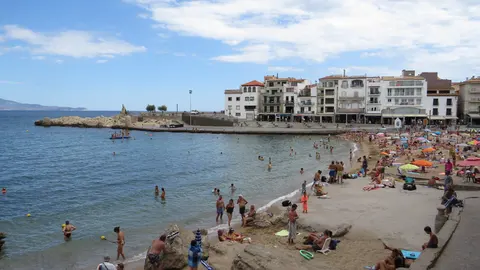
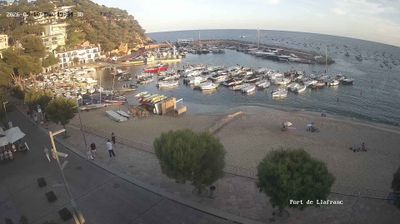
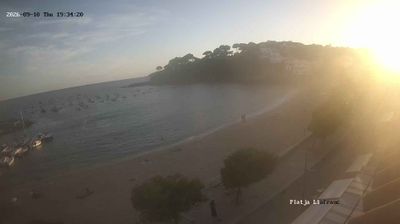
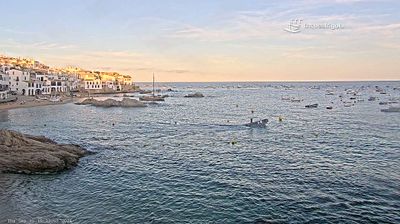
In Llafranc, one camera looks along the curve of the beach towards the rocky point that hides Calella, with the seafront promenade and its trees in the foreground. Another, which streams live, faces the other way, over the sand to the small harbour packed with boats under the pine-covered hill. In Calella, the view is low and close to the water: the whitewashed, arcaded houses of the old fishing quarter on the left, granite rocks in the foreground and the open sea, often sparkling with the morning sun. A 24-hour time-lapse of Llafranc shows how the beach fills and empties through the day.
Llafranc webcam: from the promenade to the harbour
This camera stands at the southern end of Llafranc's seafront and looks north-east along the promenade and the beach to the harbour. In the foreground are the paved promenade, its round-topped trees and the start of the sand; beyond them the beach runs to the boats moored in the small port, with the breakwater reaching out under the wooded hill.
It is the camera to check the beach before going down: whether there are people on the sand, what the sea is doing at the water's edge and how calm the harbour is. It plays as a time-lapse of the last 24 hours, so you can scroll back to the morning.
Llafranc beach towards Calella
From above the north end of the seafront, this camera looks south along the length of Llafranc beach. On the right are the promenade, the low walls and the trees; in the centre the curve of golden sand; and at the far end the rocky, pine-topped point with villas on its slopes, beyond which lies Calella de Palafrugell.
It is a good view for seeing how much of the beach is free and for watching the small waves along the shore, with the open water of the bay on the left of the frame.
Calella de Palafrugell, Port Bo and the rocks
This camera sits low over the rocks of Calella de Palafrugell and looks along the coast towards the old fishing quarter. On the left are the whitewashed houses and arcades of Port Bo; in front, granite boulders and the clear, shallow water of the cove; and to the right, the open sea stretching away to the horizon.
The view faces east, so on a bright morning the sun lays a broad path of light across the water. It is the camera to see how clear and calm the sea is for a swim off the rocks, and whether the small beaches tucked between the houses are already busy.
Writers, gardens and a lighthouse
Llafranc has long attracted artists and writers; the English novelist Tom Sharpe, author of Wilt and Porterhouse Blue, lived here. On the headland above the village, the Sant Sebastià lighthouse is the most powerful on the Catalan coast, beside the ruins of an Iberian settlement and a 15th-century watchtower. South of Calella, the castle and botanical gardens of Cap Roig were created between 1929 and 1975 by a Russian émigré, Nicholas Woevodski, and his English wife, Dorothy Webster.
When to watch Llafranc and Calella
The coast here faces east and south-east, so sunrise comes straight out of the sea and the cameras are at their brightest from early morning. Spain is one hour ahead of the UK and Ireland. Early mornings in winter are the quietest, with only the small fishing boats on Calella's sand; in high summer both beaches are busy from mid-morning. Easterly storms bring the biggest waves of the year.
Around Llafranc and Calella
The Camí de Ronda, part of the GR 92, links the two villages along the rocks past the 16th-century Torre de Calella, and continues north up to the lighthouse and on to Tamariu, about 2 miles (3 km) away. Palafrugell itself, a short bus ride inland, has the Cork Museum and Plaça Nova, its lively main square.
Visiting Llafranc and Calella
Girona airport is about 22 miles (36 km) away as the crow flies. Buses from Palafrugell serve Llafranc, Calella and Tamariu, and there are direct coaches between Palafrugell and Barcelona.