What you can see on the Montserrat webcams
From the valley floor beside the river Llobregat, one camera follows the cables of the Aeri cable car up a great wall of cliffs, often with a yellow cabin on its way up or down, and the main road and car park below. High above, another looks down the steep track of the Sant Joan funicular into a wooded gully, with the monastery buildings at the bottom and the rounded rock towers above them. Both are still images, and each is also replayed as a time-lapse of the last 24 hours.
The Aeri cable car climbing to the cliffs
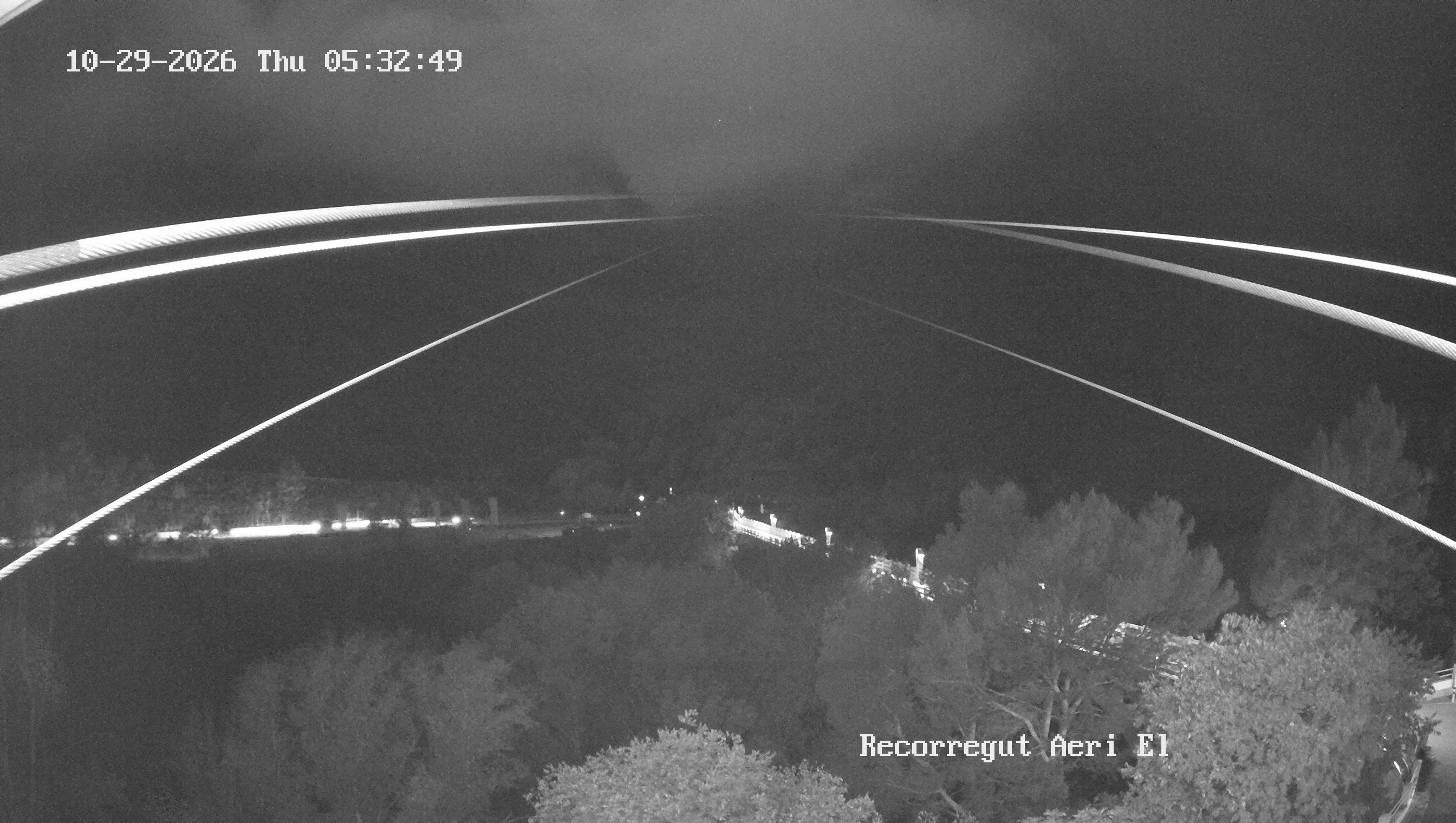
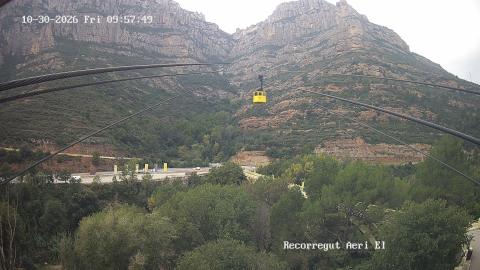
Set at the lower station of the Aeri de Montserrat, beside the river Llobregat, this camera looks along the cables as they sweep up to a notch between two great walls of conglomerate. A small yellow cabin is often visible on the way up or down. Below, beyond the riverside trees, are the C-55 road and the car park where visitors leave their cars.
The cable car has run since 1930 and climbs 544 m (1,785 ft) in about five minutes. What matters in this picture is the top of the cliffs: when cloud sits on them, as it can while the valley is clear, the view from the monastery will be white. A still image with the date and time on it, also replayed as a 24-hour time-lapse.
Down the Sant Joan funicular to the monastery
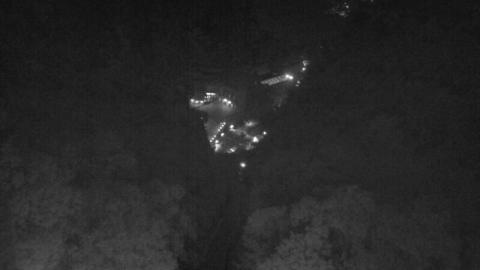
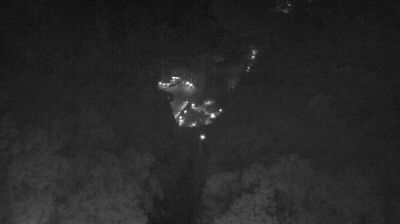
High on the mountain, this FGC camera looks straight down the single track of the Sant Joan funicular, the steepest in Spain, as it drops into a wooded gully. At the bottom of the gully stand the monastery buildings and the square in front of them, and on the left rise the rounded towers of conglomerate that give Montserrat its jagged outline. Sometimes one of the funicular's cars is on the track.
When cloud drifts up the gully, the picture turns white, and that tells you at once whether a walk on the upper paths will have a view. It is a still image with the time printed in the corner; the same view is replayed further down as a 24-hour time-lapse.
A mountain of conglomerate
Montserrat is made of conglomerate, pebbles cemented together in an ancient river delta and worn by erosion into hundreds of rounded towers. Its highest point is Sant Jeroni, at 1,236 m (4,055 ft), and the mountain has been protected as a natural park since 1987. Getting up has been part of the adventure for almost a century. The Aeri, built with German technology, opened in 1930 and climbs 544 m (1,785 ft) in about five minutes. The Sant Joan funicular, the steepest in Spain, carries walkers from the monastery to the paths along the upper mountain.
When to watch Montserrat
Montserrat is one hour ahead of the UK and Ireland. Low cloud can wrap the upper cliffs while the valley stays clear, and the cable car camera shows it best: if the top of the frame is white, so will be the view from the monastery. Summer afternoons can be hot and hazy; spring and autumn are the most comfortable seasons for walking on the mountain.
Around Montserrat
Beyond the monastery and its basilica, marked paths lead to old hermitages and up to Sant Jeroni, and the Santa Cova funicular drops towards the chapel of the Holy Cave. The rock towers, such as the Cavall Bernat, are classic climbs.
Getting to Montserrat
Barcelona's El Prat airport, with many flights from the UK and Ireland, is about 24 miles (39 km) away as the crow flies. FGC trains from Plaça d'Espanya in Barcelona run to the foot of the mountain, where you change to the Aeri or, at Monistrol, to the rack railway. By car, the C-55 runs past the lower station of the Aeri.