


What you can see on the Santiago de Compostela webcams
Live video covers the three great squares around the cathedral: the Obradoiro in front of the west facade, the Quintana with the Holy Door, and Praterías with its Romanesque doorway. Inside, one camera watches the transept where the botafumeiro swings and another, with sound, looks into the main chapel. A weather camera and a 24-hour time-lapse of the Obradoiro complete the set.
The cathedral's west front across the Obradoiro
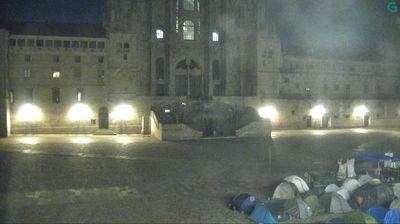
This camera sits on a balcony of the Pazo de Raxoi, the 18th-century building on the west side of the Praza do Obradoiro that houses the city council and the presidency of the Galician government. It moves between a few set positions. Straight ahead is the baroque Obradoiro front of the cathedral, with its twin towers and double staircase, the facade engraved on Spain's 1, 2 and 5 cent coins. To the left stretches the Hostal dos Reis Católicos, founded in 1492 as a pilgrims' hospital and now a Parador; to the right, the Colexio de San Xerome closes the square.
These flagstones are where the Camino ends, so this is the view to watch for walkers arriving with rucksacks and poles. The cathedral faces west and is lit by the sun from mid-afternoon.
The Holy Door side of the cathedral
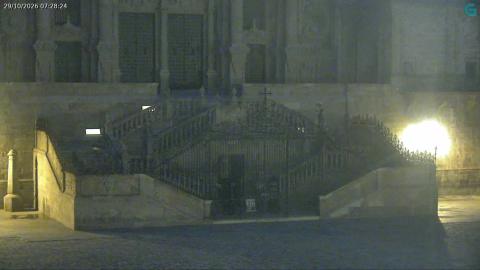
The Praza da Quintana lies behind the cathedral, and this fixed camera looks across it to the church's east end. On the left rises the Berenguela, the clock tower whose bell strikes the hours over the old town. In the centre is the baroque Porta Real, the royal door, with the royal arms over it; to the right, closest to the broad flight of steps, is the Porta Santa, the Holy Door. It opens only in Holy Years, when 25 July, St James's Day, falls on a Sunday, and in those years the lantern on top of the clock tower stays lit.
The Quintana is calmer than the Obradoiro: people cross it on their way round the cathedral, sit on the steps or stop at the stalls along the wall.
The Romanesque Praterías doorway and the horse fountain
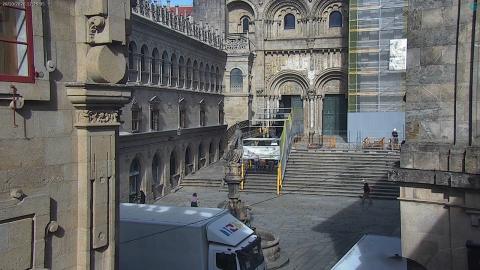
From the Casa do Deán, an 18th-century house at the top of the Rúa do Vilar, this camera looks up the steps to the Praterías doorway on the south side of the cathedral. Dating from 1103 and the work of Master Esteban, it is the oldest of the cathedral's facades: twin round arches crowded with carved figures, set into the Romanesque wall of the transept. The square is named after the silversmiths (prata means silver) who worked here.
In the middle stands the Fonte dos Cabalos, a fountain of stone horses below a figure on a column; on the left runs the long, richly carved wall of the cathedral cloister. Walkers coming up the Rúa do Vilar pass right under the camera, and the shade of the cloister wall moves across the square through the day.
Santiago's weather from San Lázaro
MeteoGalicia, the regional weather service, has a station on high ground at San Lázaro, on the eastern edge of Santiago, the district through which the French Way enters the city. Its camera looks west over the rooftops: trees and a car park in the foreground, long rows of red roofs, and in the middle distance the old town on its ridge, with the cathedral's spires small on the skyline. Wooded hills close the horizon.
Most of the frame is sky, and that is the point: in one of the wettest cities in Spain, it shows at a glance whether the cloud is low and grey or the sun is out before you set off to walk in. It is a still image, not a video: the reload button brings up the latest one it has sent, stamped with the date and time.
The botafumeiro's flight path, inside the cathedral
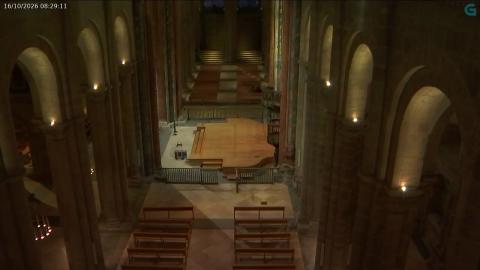
Mounted high inside the cathedral, this silent camera looks north along the transept, the arm of the church that crosses the nave in front of the high altar. Pews fill the nearest stretch; beyond a low railing comes the carpeted crossing, then more pews and, at the far end, the north door that opens on to the Azabachería side.
This is exactly the line of the botafumeiro. When the great silver-plated censer is used, eight robed men called tiraboleiros haul on its rope until it sweeps from one end of the transept to the other, almost reaching the vault, at up to about 68 km/h (42 mph). It flies on the main feast days and at some other Masses, not at every service, so for most of the day the camera shows visitors walking quietly through.
St James's high altar, live with sound
This is the cathedral's own broadcast, and the only camera on the page with sound. From the right-hand side of the nave it looks into the main chapel: the gilded baroque canopy, the silver altar and, at its heart, the 18th-century silver-clad figure of St James that pilgrims climb up behind to embrace. The Apostle's relics lie in a silver casket in the crypt below. In front, a plain altar table stands on a red-bordered carpet, often decked with flowers.
Services are carried live, including the pilgrims' Masses that mark the end of so many journeys, so you may hear readings, hymns and the organ. Between services the sound is the hum of visitors moving round the ambulatory behind the altar.
Walking from these islands
Pilgrims from Britain and Ireland have made this journey since the Middle Ages, many of them by sea to Ferrol or A Coruña and then on foot along what is still called the English Way. Today the Pilgrim's Office gives the Compostela certificate to anyone who has covered at least the last 100 km (62 miles) on foot. Brian Sewell's series The Naked Pilgrim and the film The Way sent many more British and Irish walkers down the trail. In Holy Years, when St James's Day, 25 July, falls on a Sunday, the Holy Door opens and the crowds grow larger still.
When to watch Santiago de Compostela
Santiago keeps mainland Spanish time, one hour ahead of the UK and Ireland, and lies so far west that it stays light until about 10pm local time in midsummer. The cathedral's west front catches the afternoon sun. The great day is 25 July, with the botafumeiro swinging inside; on the night before, fireworks are traditionally set off in front of the facade. And pack a coat: with about 1,800 mm (71 in) of rain a year, roughly three times London's, Santiago is one of the wettest cities in Spain.
Around Santiago
About 3 miles (5 km) east, the hill of Monte do Gozo is where walkers on the French Way catch their first sight of the cathedral towers. Many carry on beyond the city to Cape Finisterre and Muxía on the Costa da Morte, about 55 miles (90 km) west. The Alameda park, just west of the old town, has the classic view of the cathedral above the rooftops.
Getting to Santiago de Compostela
Santiago's airport, at Lavacolla, is about 8 miles (13 km) east of the city and has direct flights from the UK and Ireland; the Camino itself runs right beside its runway. Buses link it with the centre, and trains run to A Coruña, Vigo and Ourense.