
What you can see on the Valdoviño webcams
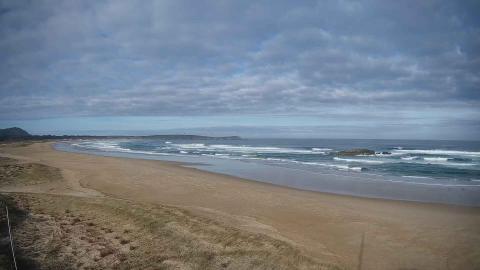
Both live cameras belong to the town council. One looks along A Frouxeira from the dunes: a huge sweep of sand, a rocky islet close to the shore and a lighthouse on the far headland. The other faces straight out to sea at Pantín, a smaller bay closed on the right by a steep green headland, with a few rocks offshore. They exist for one reason, to show the sea: lines of swell and how cleanly they break, ripples or white caps from the wind, and the morning fog that sometimes sits on this coast in summer.
Valdoviño beach webcam: A Frouxeira
The council's camera stands in the dunes behind A Frouxeira, the longest beach in Valdoviño, and looks along the shore. Dune grass and a fence post fill the foreground; then comes a broad apron of sand, the white lines of the surf, a dark rocky islet just offshore and, in the distance, the headland with its lighthouse closing the bay.
With so much beach in one frame, this is the view for counting sets of waves and seeing where they break. A wide band of wet, shining sand between the dunes and the surf means the tide is out. On summer mornings, check here for fog before driving out.
Pantín surf webcam, Valdoviño
Set back from the beach at Pantín, this live camera looks straight out to sea over a wide sweep of golden sand. A steep, grassy headland with reddish cliffs closes the bay on the right, and a few low rocks break the horizon on the left. The waves arrive head-on, so you see each set build, peak and break across the whole bay.
This is the beach of the Pantín Classic, and a camera surfers check before they paddle out. Long, even lines with little texture on the water mean clean conditions; choppy, crumbling waves mean the wind has got up. At low tide shallow pools spread across the sand, and on quiet days you can pick out a lone surfer or a dog walker at the water's edge.
Surfing Valdoviño
Pantín hosts the Pantín Classic, a professional contest held each September that has brought international surfers here since the late 1980s. If you surf in Cornwall, Bundoran or Lahinch, the conditions will feel close to home: powerful Atlantic swell, cool water and a wetsuit in every season. Beginners usually find softer waves on the long, open stretches of A Frouxeira, and the local surf schools pick the beach to suit the day. Behind the sand, the A Frouxeira lagoon is a protected wetland and a stop for migrating birds, worth a walk when the sea is flat.
When to watch Valdoviño
Autumn and winter bring the biggest swells, often too big to surf; spring and early autumn give the most surfable days. In summer the sea is usually gentler and good for learning, but early fog is common and can take until late morning to lift. Valdoviño keeps mainland Spanish time, one hour ahead of the UK and Ireland, so an 8am check on the camera is 7am back home.
Around Valdoviño
Ferrol, with its 18th-century naval dockyard, is about 9 miles (15 km) south. Northwards the coast climbs towards Cedeira and the Serra da Capelada, where the cliffs of Herbeira are among the highest sea cliffs in Europe, and the tiny sanctuary village of San Andrés de Teixido looks down on the ocean.
Visiting Valdoviño
You need a car: A Coruña and its airport are about an hour's drive away. These are exposed beaches with strong currents, and lifeguards cover them only in the summer season. Outside it, swim only if you are confident in Atlantic surf, and never alone.