
What you can see on the El Palmar webcams
Both cameras stream live. One looks across the beach road and the low dunes to the sand and the sea, with the surfers' cars pulling up alongside in the morning. The other, at a surf school, looks straight out over the beach and frames the surf zone more closely. At low tide flat rock shelves appear at the water's edge; at high tide the sea comes far up the sand. Between them they answer the two questions surfers ask first: is there a wave, and how many people are already out?
El Palmar beach webcam, live
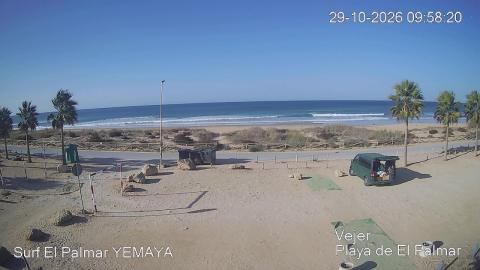
This live camera looks over El Palmar from beside the sandy beach road, with the open Atlantic straight ahead. In the foreground is a dirt car park with a barrier and a few palms; across the road, fenced dunes and grasses lead down to the beach, where you can usually make out the surfers gathered at the water's edge.
It is the quickest way to answer the morning question on this coast: are there waves, and how busy is it? Lines of white water breaking well out mean swell; a flat blue sea means a beach day rather than a surf day. The parked cars tell you how many people have beaten you to it, and the palms show the strength of the wind. Late afternoon brings the softest light.
El Palmar surf cam, live from a surf school
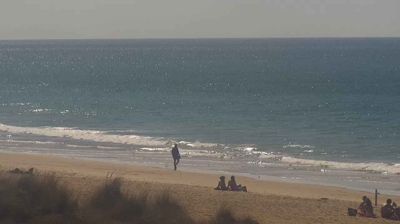
Installed at a surf school facing the beach, this live camera looks straight out to sea over the dunes and the sand of El Palmar. A wooden fence and dune grass fill the foreground; beyond them the wide beach runs down to the surf zone, where flat ledges of rock appear along the water's edge at low tide.
The framing is tighter than the other El Palmar view and aimed at the waves rather than the road, so the detail is in the water: the lines of swell as they arrive, how cleanly they break over the sand and the rocks, and how many surfers are already out. Morning frames often show glassy conditions before the afternoon wind, and the light turns golden as the sun drops towards the Atlantic.
A beach without towers
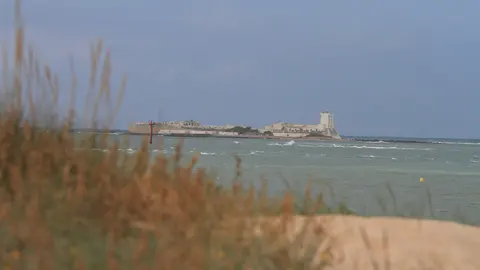
The Costa de la Luz is the Atlantic side of Andalusia, and El Palmar shows what it looks like where building stayed small: a scattered line of houses, beach bars and surf camps behind the dunes, and a coastal watchtower, the Torre de El Palmar, one of the many towers that once kept watch over Spain's shores for raiders from the sea.
When to watch El Palmar
Mainland Spain is one hour ahead of the UK and Ireland all year. The beach faces south-west, so mornings are often glassy before the wind gets up, and in the evening the sun sets over the ocean. From autumn to spring the Atlantic sends in its bigger swells; summer waves are usually small and kinder to beginners.
Around El Palmar
To the south, the coast road leads to Los Caños de Meca and Cape Trafalgar, off which Nelson's fleet defeated the French and Spanish in 1805; the cape's lighthouse stands at the end of a sandy spit. Conil de la Frontera lies just to the north, and Vejer, one of the most admired white towns of Andalusia, is a short drive inland.
Visiting El Palmar
There is no town centre, so parking is along the beach road, and it fills up in July and August. Surf schools along the road hire out boards and wetsuits. Currents can form along the sandbanks: in summer, swim where the lifeguards are posted and follow their flags.