What you can see on the Vall de Boí webcams
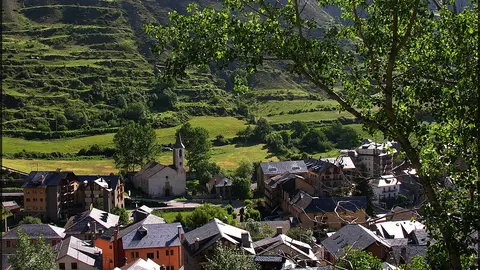
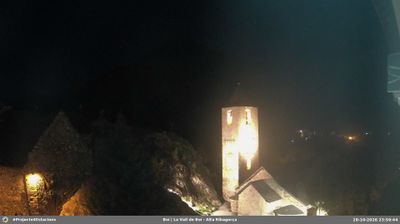
In Boí the camera looks past old stone houses to the square bell tower and the nave of the church of Sant Joan, with the steep, rocky mountainsides of the valley behind and a village on the far slope. In Taüll it looks down over the slate roofs of the village to the green meadows and woods of the valley floor, with the mountains on the far side.
The slate roofs of Taüll
Taüll stands high on the east side of the Vall de Boí, below the ski slopes of Boí Taüll, and this camera looks out over the village from a high point. In the foreground, a tight cluster of stone houses with dark slate roofs and dormer windows; beyond them, green meadows and woods on the valley floor and the mountains on the far side, with high, rounded summits on the skyline.
On sunny mornings the low sun can flare in the lens. The camera is most useful in winter, for seeing snow on the roofs and the road up from the valley, and in autumn, when the woods below the village change colour. It comes through Windy as a time-lapse of the day.
Sant Joan de Boí and its bell tower
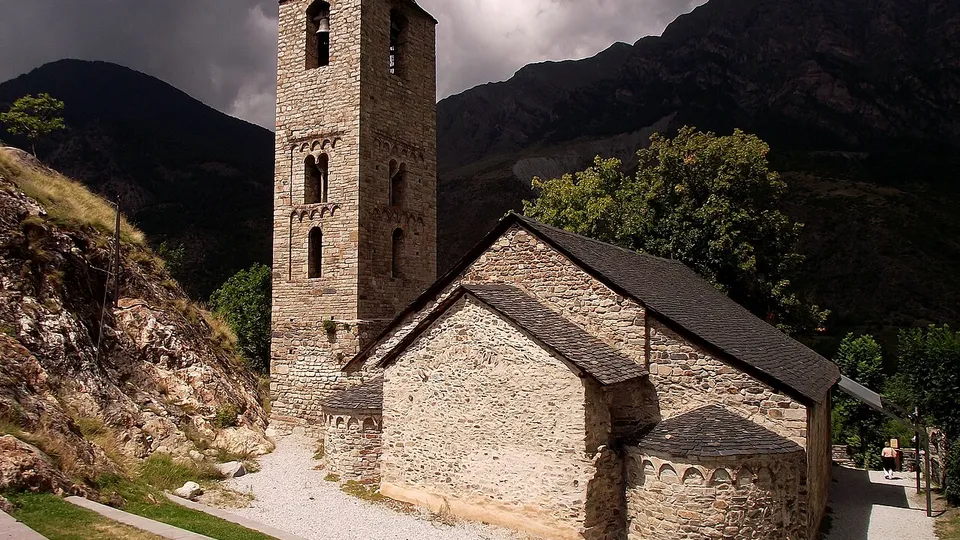
This camera looks north-west across the village of Boí to the church of Sant Joan, one of the nine Romanesque churches of the valley listed by UNESCO. On the left are old stone houses with slate roofs; in the centre, the church's square bell tower with its paired windows and Lombard arches stands above the nave and the path that leads to it; behind, rocky, forested mountainsides rise steeply, with a village on the slope opposite.
It shows the light on the stone and the weather on the mountains above the valley, from the morning sun to afternoon storms, and in winter whether snow lies on the roofs. It comes through Windy as a time-lapse of the day.
The Romanesque churches
The churches were built in two stages: those of Boí around 1100, and those of Taüll, Sant Climent and Santa Maria, consecrated in 1123. Their slender bell towers in the Lombard style, decorated with blind arches, are the signature of the valley. Inside, they were covered in wall paintings; in the early 20th century most were removed to the National Art Museum of Catalonia in Barcelona to protect them, and copies have taken their place. The apse of Sant Climent de Taüll, with its Christ in Majesty, is counted among the masterpieces of European Romanesque painting.
When to watch Vall de Boí
The valley is one hour ahead of the UK and Ireland. It is a deep valley, so on winter mornings the sun reaches the valley floor late, and on summer afternoons storms often build over the peaks. In winter, the cameras help to judge the road up to Taüll and to the ski slopes of Boí Taüll, the resort above the village.
Around Vall de Boí
Boí is the western gateway to the Aigüestortes i Estany de Sant Maurici National Park, with its hundreds of lakes; from the edge of the park, taxis and walking paths lead into the Aigüestortes meadows. At the head of the valley are the spa of Caldes de Boí and the Cavallers reservoir, the start of several high walks. The other churches of the group stand in Barruera, Erill la Vall, Durro and Cóll, all within a few miles.
Visiting Vall de Boí
The nearest airport with flights from the UK is Toulouse, about 138 miles (222 km) away, a little over three hours by car through the Val d'Aran. Barcelona is about 183 miles (294 km). The valley is reached from El Pont de Suert, and the road to Taüll climbs steeply from the valley floor.